

Heard us on
The AI Daily Brief Podcast?

Heard us on The AI Daily Brief Podcast? For AI, we're all in on AWS. Let's build AI teammates for your enterprise.

Women in Tech Recommended Books, Podcasts, and More

At our most recent Women in Innovation event, our accomplished panelists shared the podcasts, books, newsletters, and other resources they recommend for women in the tech field. We’ve compiled their picks below along with a few bonus suggestions for must-read women in tech books from the talent at Robots & Pencils.

Recommendations from Asha Aravindakshan
Best-Selling Author and Tech Leader

Asha Aravindakshan

How Women Rise: Break the 12 Habits Holding You Back from Your Next Raise, Promotion, or Job | By Sally Huddleson and Marshall Goldsmith

How Women Rise offers a modern take on Marshall Goldsmith’s classic, What Got Here Won’t Get You There. This book explicitly acknowledges that women face different obstacles in their careers from men. The authors highlight the behaviors that help women start their careers but then keep them from rising to higher levels. Along with naming 12 of these behaviors, they provide clear examples of how each can hold you back and what to do instead to move forward.

Skills: The Common Denominator | By Asha Aravindakshan

Our career paths (and our lives) rarely follow a straight path. If you’re planning a career move, this book offers insights and guidance for everything form comparing industries, roles, and organizations to utilizing your professional and personal networks. Featuring 25 inspirational stories of career changes, Skills will help you assess, identify, and showcase your transferable skills. Ultimately, you’ll learn how to stand out among candidates while creating a career that brings you joy. 

Recommendations from Andrea Chin
Expert in Digital and Disruptive Technology

Andrea Chin

The Female Quotient 

The Female Quotient is an organization committed to raising the visibility of women and advancing equality. They host events, develop content, and provide advisory services to organizations. Andrea recommends signing up for their newsletter to stay up-to-date with the group’s work.

Fairy GodBoss 

Fairy Godboss is a community designed to help women find jobs, career advice, and support. Membership is free and includes access to job search features, company reviews, and events. Fairy GodBoss also has a daily newsletter that covers career trends, discussions, and new articles.

Athena Alliance  

Athena Alliance supports female leaders through educational content, coaching, courses, in-person meetups, networking, and community.

Recommendations from Natalie Farand
Client Experience & Digital Product Senior Leader

Natalie Farand

Women at Work

Hosted by Amy Bernstein and Amy Gallo, this podcast is affiliated with the Harvard Business Review. It explores all sorts of topics related to women at work from entrepreneurship to vulnerability to joining a board. Natalie says it’s one of her go-to podcasts she listens to while she gets ready every morning.

The New Rules of Business

This podcast by Chief is another of Natalie’s favorites. While Chief is primarily a private network for executive women, anyone can sign up for their newsletter and listen to their podcast, The New Rules of Business. On this podcast, Chief Co-Founders Carolyn Childers and Lindsay Kaplan dive into complex marketplace trends and challenge established ideas about leadership. 

Books for Women in Tech: R&P Team Recommendations

As part of our celebration of the history and future of women in tech, we asked our talent what books they recommend for other women in tech.

Burnout: The Secret to Unlocking the Stress Cycle | by Emily Nagoski PhD and Amelia Nagoski DMA

Suggested by Tahishia Simmons, R&P’s Director of Managed Services, this book examines how the world views women differently than men and the pressure they face as a result. The book offers women tools to manage and overcome the stressors that have left you exhausted.

Big Feelings: How to be Okay When Things are Not Okay | by Liz Fosslien and Mollie West Duffy 

Jen Suehr, our Product Ownership Associate Practice Lead, recommends this book if you’re looking for advice and strategies for managing tough feelings like envy, burnout, and anxiety.

Girl, Stop Apologizing | by Rachel Hollis

Recommended by R&P Account Manager Brittany Peterson, this book challenges women to replace old excuses with new behaviors, skills, and the confidence to grow and achieve their dreams.

Lean In: Women, Work, and the Will to Lead | by Sheryl Sandberg

Simranjeet Kaur, Senior QA Robot, chose this classic book as her recommendation for fellow women in tech. The book offers practical advice to help you build a fulfilling career, covering topics like mentorship, negotiation, and taking risks to achieve your goals.


Women in Tech: Shaping the Future

As Robots & Pencils celebrates 15 years in business this year – and Women’s History Month this March, we reflect on the journey that has brought us to where we are today and the many women of tech who have helped us get here. From the start, women have been vital to our growth and the development of innovative solutions for our clients. In fact, one of our two co-founders (and the original pencil!) was a female. Since then, many talented women have joined our ranks and made their marks in leadership and individual contributor roles.

However, the story of our tech company has not historically been the norm. While the history of women in technology is full of perseverance, innovation, and progress, many obstacles have hindered women’s full participation and recognition in the field. As we stand at the cusp of a new era, it’s crucial to acknowledge our past and understand our present. Only then can we envision a future where diversity is not just encouraged but celebrated as a cornerstone of innovation.

Reflecting on Our Roots

The history of women in technology is rich with figures who defied the norms of their times. These pioneers contributed foundational work in computing and engineering. From Ada Lovelace, the first computer programmer, to Grace Hopper, who developed the first user-friendly software programs in the 20th century, women have been instrumental in shaping the technology landscape. Despite their contributions, for too long, women’s roles were marginalized and their achievements overshadowed.

The late 20th and early 21st centuries marked a turning point, with more women entering STEM fields and making significant strides in tech. However, the journey has been far from smooth. Women have faced a myriad of challenges, from gender bias and a culture that can be unwelcoming to females to a lack of representation as women look up the leadership ladder.

The Present Landscape for Women in Tech

Today’s tech industry is more diverse than it was decades ago. Still, women only account for approximately one-third of the tech workforce. That number drops further in technical and leadership positions. The reasons are complex and multifaceted, from societal and cultural norms to policies and practices within the industry itself.

More than ever, there’s a growing movement to change the narrative. Initiatives to close the gender gap, such as STEM education programs for girls, mentorship programs, and women-led tech startups and VC funds, are gaining momentum. Organizations are increasingly recognizing the value of diversity, not just as a moral imperative but as a business one. Numerous studies have shown that diverse teams are more innovative and perform better financially. 

Envisioning a Better Future

Looking to the future, we are optimistic about the impact of women in tech. Technology is at the heart of societal transformation, and the need for diverse perspectives will be critical as society confronts global challenges. Here are some specific ways we see the future of women in tech evolving.

Increased Representation: STEM education efforts and increased adult learning options will translate to more women entering the tech workforce. We anticipate an increase in the number of women not just in entry-level positions, but in senior leadership roles and fields like AI, machine learning, and cybersecurity.

Policy and Practice Changes: Companies with inclusive policies and practices, including flexible working arrangements that support work-life balance, will attract more female candidates. Mentorship programs are also becoming more common, providing women with increased guidance and opportunities to advance their careers.

Women Leading Innovation: Women will not continue to not only participate in the tech industry but lead some of the most significant innovations. Female tech entrepreneurs will be at the forefront of developing groundbreaking technologies and solutions that create a better world.

Advice for Women in Tech

At our women in innovation events, our speakers often advise attendees to both seek and provide mentorship. The guidance and support of someone who has navigated the world you’re facing can be invaluable. Equally, by mentoring others, you help to build a more inclusive and supportive tech community.

Another refrain is to stay curious. The tech field is constantly evolving. Continuous learning is key to staying ahead. Embrace challenges as opportunities to grow, and never underestimate the value of your unique perspective. 

Finally, advocate for yourself and others. Be vocal about your achievements and the contributions of other women in tech. Change happens when people collectively raise their voices to highlight injustices and push for progress.

The future of women in tech is bright, but realizing it requires a concerted effort from individuals, organizations, and society. Together, let’s commit to breaking down those barriers that remain and building a tech industry that is truly inclusive, equitable, and representative of the world it serves. 

The Best Leadership Books I Read Last Year

6 Recent Reads That Have Impacted My Approach and Thinking as a CEO 

I’ve been a reader my whole life. I practically read a book a day when I was a kid (all fiction, of course!). As I got older, life got busy, and I had less time for fiction. I was starting a career in software development and learning as I went. After a few years in the field, I decided to focus less on reading tech-focused books, which I was fortunate that my job gave me the time and opportunity to do, and start reading business books. Before long, I formed a habit. I was always looking for the best business and leadership books that would help me, and later my teams and my company, grow. 

Today, the books I consume continue to shape how I approach solving problems, making decisions, and building relationships. However, I realized last year that I now read almost entirely leadership and business advice (see my 2022 reading list, for example). As a result, I vowed to expand into more genres. While I still haven’t spent much time back in the world of fiction (though over the holidays I started reading Andy Weir’s Project Hail Mary at my teammate’s recommendation!), I did add biographies into the rotation. At least I’m getting more of a story! 

The 6 Best Leadership Books I Read in 2023

If you’re looking for your next read or a gift for a business leader in your life, here are a few of my recent favorites.

Four Seasons: The Story of a Business Philosophy

By Isadore Sharp

This is an inspiring story of a seemingly ordinary person–a child of immigrants and a son of a builder–doing extraordinary things. Isadore Sharp, the founder and chairman of Four Seasons, shares how he developed a brand now known worldwide by following his gut, taking big risks, persevering, and committing to his vision. You’ll learn where he drew inspiration and ideas from and see the power of asking for what you want. Sharp’s memoir also reinforces the importance of building relationships, earning trust, and being true to your word.

Building a Second Brain: A Proven Method to Organize Your Digital Life and Unlock Your Creative Potential

By Tiago Forte

This book isn’t just one of the best leadership books I read this year–it’s one of the best all-around books on this list. Everyone can benefit from this, and I certainly took a ton of notes! Building a Second Brain is full of practical tips for those of us juggling to-dos and information for our teammates, clients, loved ones, and more. The techniques will help you remember, capture, organize, distill, and express your ideas, notes, and work to maximize the value and impact on your life. The book can also guide you in deciding what information to keep and what to let go of. Reading this has helped me be more systematic and strategic in both my personal and professional life. Shout out to my friend and fellow CEO, Patrick Patterson, for this sanity-saving recommendation.

The Power of One More: The Ultimate Guide to Happiness and Success

By Ed Mylett

In this motivational book, Ed Mylett urges us to keep pushing when we would otherwise stop. He emphasizes how much we stand out and achieve when we are willing to go above and beyond expectations. Take the additional meeting. Do one more round of practice. Over time, this philosophy will pay off in surprising ways! (Haven’t heard about Ed Mylett? Look up some of his talks on YouTube for a preview of what to expect with this book!) 

Boundless: A New Mindset for Unlimited Business Success

by Henry King and Vala Afshar 

King and Asfhar draw on years of experience leading digital teams and transformation initiatives to outline a path to business success. The pair focus on how to overcome silos inside your organization to enable the free flow of information and resources. The book focuses on seven areas: connection, integration, decentralization, mobility, continuity, autonomy, and shared success. I’m fortunate to know the co-authors in real life and know that they also practice what they preach!

Soundtracks: The Surprising Solution to Overthinking

By Jon Acuff

Are you an overthinker? Don’t worry – you’re in good company! We’ve all occasionally fallen into the pattern of overthinking. This book is an easy read that prompts you to examine the soundtracks (the thoughts) that repeat in your head. It then provides a guide to help you change what your brain tells you. Once you take control, you get back time to accomplish what you want while also unlocking your creativity in productive ways.

Titan: The Life of John D. Rockefeller

By Ron Chernow

Titan is a fascinating look at a person with an incredible impact on industry in the United States. It’s a very long read (or listen, in my case), but I kept coming back to it throughout the fall and winter. This biography examines the rise of an ordinary man to immense power and, along the way, reveals how so many things we take for granted first came to be. If you’re interested in American history and business (and it all really wasn’t that long ago!), I’m certain you’ll enjoy this book.

Want to share the best leadership books you’ve read?

Send me a note on LinkedIn – I’m always open to recommendations, and your book might just make my next list. Happy reading!

2024 Kickstart: Our Top Resources for Business Impact

Revisiting our Most Valuable Tech Advice and Insights from 2023

AI has been a major focus over the last year, and more is still to come!

Bringing Intentionality to AI: Why today’s design methods fall shorts for LLMs and what to do instead
In this on-demand webinar, Executive Experience Director Tyler Klein challenges conventional approaches to user-centered design and explains why they fall short in Generative AI experiences. He instead proposes a new model for the design of emergent experiences.

Training Artificial Intelligence with Real Heart: Legitimize, Confirm, Reinforce
In this blog post, Client Strategy Analyst DJ Moody explores the challenges of designing AI chatbots. Drawing on lessons from the intersection of the sciences and the humanities, DJ shares three principles for training artificial intelligence to deliver personalized customer experiences.

Summoning the Ghost in the Machine: Intro to Prompt Engineering and Design
Watch this presentation to learn about prompt engineering, where creativity and ingenuity converge with cutting-edge AI technology to produce mind-blowing outcomes. Prompt engineering is a dynamic and rapidly growing product role that’s accessible to everyone, regardless of your technical background.

Unlocking AI’s Human Potential: Human First, Tech Second
This virtual summit on unlocking AI’s human potential featured our CEO Tracey Zimmerman and Executive Experience Director Tyler Klein together with guest speakers from Ingram Micro, Arizona State University, and Slack.

Our CEO shared her thoughts on the technology and business landscape.

CEO Report: Maximizing Impact and Future-Proofing Your Business in an Ever-Changing World
In the first of her blog post series, Tracey Zimmerman shares what she’s hearing and seeing in the marketplace, including the top factors influencing decisions and areas with the biggest opportunity for organizational impact.

From Chaos to Clarity: The Journey to Modernization
Join Tracey for a dive into digital modernization. Get tips on how to unify fragmented data and unlock hidden insights, to increase flexibility by addressing aging infrastructure, and prepare for the future by expanding interconnectivity in your systems.

Employee Efficiency Accelerators: The Power of Empathy, Automation, and AI
Where should you focus your efforts to boost efficiency? Tracey suggests looking to employee experience design, self-service tools, automation, and AI-human partnership. Most of all, approach every initiative with empathy and consideration for your team members. 

How to Win Big with Your Customer Experience
Explore how to create holistic, personalized experiences built around your customer journeys and preferences. Here, you’ll learn lessons on building brand loyalty, engagement, and community.

As you keep working to create forward-looking, innovative technologies and organizations, these insights can help.

A Mobile Prediction Guide for 2024
This blog post from our Mobile Practice Lead Quinn Thomson examines the current stage and future evolution of the three most common uses of mobile apps.

5-Step Guide to De-Risking Innovation for Maximum ROI and Impact
Do your new ideas stall out because of organizational risk aversion? This ebook can help you go from idea to impact faster than ever before.

The Art of the Possible with Brad Fagan
During this podcast episode, Executive Creative Director Brad Fagan shares strategies and techniques for uncovering new ideas and defining your strategic and product vision.

A Practical Guide to Planning and Prioritizing Your Tech Investments
Are you torn between warring priorities and stakeholders with differing opinions? If so then this step-by-step guide to planning and prioritizing tech investments will get you refocused on your strategic objectives.

Change Management – Creating A Culture of Innovation
In this webinar, two Client Strategy Analysts discuss how to apply change management to support individual innovations and ultimately create a culture where innovation and change are the norm.

Reimagining Your Customer and User Journeys: 10 Essential Tools
If you know your customer journey is lacking but you’re not sure where to start, how to achieve your goals, or test your theories, this ebook reviews which tools can address your needs.

Want our thoughts on another technology or design topic? Get in touch – we’d love to chat!

How a Slack App MVP is Informing Product Roadmap Decisions

Helping a Top 4 Professional Services Firm with MVP Slack App Design and Development

Have an idea for a new or improved offering? That’s a great place to be! But whether you want to build a new app, an AI-powered chatbot, or reimagined digital experience, there’s still a long road ahead and a lot of questions to ask. How do you know if that idea will work? How will you test it? When will you seek feedback? And how will you bring everyone else on board? Robots & Pencils supports clients at every stage of product design and development, including advising you on what ideas to test and how. Then, we help you get those ideas out into the world as minimum viable products (MVPs). By doing so, you can gather early feedback that will guide your future direction. Below, we share how we helped a major professional services firm test their idea with a Slack app MVP.

Recognizing the Power of Slack

One of the best things about Slack is its ability to bring together people, systems, and processes all in one place. If your organization uses Slack but doesn’t integrate other technology and workflows into the platform, you’re missing out on opportunities. Being able to interact with your systems right from Slack to get the information you need is a huge win. It benefits the employee experience and the entire organization by making work faster and more efficient.

Knowing the potential and promise of Slack, a top 4 professional services firm approached us with an idea. They wanted to give users of their Salesforce-based supplier lifecycle management solution access to the tool’s features inside Slack. This access, they hypothesized, would allow users to work more efficiently and effectively. Now, they wanted to build a Slack app MVP so that they could test the theory and demonstrate the benefits of integrating the two systems.

Creating a MVP Slack App to Test with Potential Customers

An experienced Slack services provider and longtime Slack partner, Robots & Pencils was well equipped to help our client. We provided expertise for the product strategy, UX/UI design, documentation, and development for the proof of concept Slack app. For this app, the team honed in on two important employee use cases: onboarding suppliers and collaborating on tracking issues.

In the resulting Slack MVP app, users can easily access and share new supplier details and onboarding statuses from Salesforce in Slack. Depending on their needs, users can share supplier info in channels or conversations. For issue tracking, our developers set up the integration so that new incidents added in Salesforce automatically post in Slack. As issues arise, users can discuss and collaborate on problems in real time. After an issue posts in the incident channel, users can also share it to other channels and conversations. Additionally, the Slack posts contain links that users can click on to see more details about the supplier or incident in Salesforce.

Robots & Pencils also assisted in configuring Slack and Salesforce to automate the app deployment process to the client’s internal AWS environment. Now, the client is demoing the MVP to customers and potential stakeholders to gauge interest in the app and its features. Already, the process has provided valuable insights for improving their product and refining their roadmap.

How to Get Started on Your Product Idea

If you’re ready to take the next steps on your product idea, Robots & Pencils is here to help. Early on, we’ll leverage stakeholder and user interviews combined with quantitative studies to uncover unmet needs and opportunities to innovate. In design and product vision workshops, we’ll align your team on goals, plans, and priorities. When you’re ready, we’ll partner with you to conduct technology and creative experiments to test the feasibility of your ideas and how they resonate with users. Of course, we also assist with agile product development, from designing and building products to measuring performance and learning in ways that power continual improvement and growth. Rounding it out, we deliver change management strategies and services that maximize business impact.

Want more information? Contact hello@robotsandpencils.com today!

Training Artificial Intelligence with Real Heart: Legitimize, Confirm, Reinforce

Insights for training AI chatbots

This post is written by DJ Moody, Client Strategy Analyst at Robots & Pencils, and inspired by a recent experience helping one of our clients with creating and training an AI chatbot.

“Alright listen, Sparky…”

My father tends to be laid-back. However, there are clear indicators when he’s getting frustrated. These are so predictable that the whole family knows when a customer experience goes awry. First, he refers to the person as “Buddy”. If the situation doesn’t improve, they soon become “Sport”. With each step down this path of names, the chances the agent will keep the business drop precipitously. The final moniker is “Sparky”. No one comes back from Sparky.

It’s a familiar experience. A customer service discussion goes poorly. We become frustrated. Eventually, if it’s bad enough, we decide to spend our money elsewhere. After those conversations, our opinion of the company changes. We blame the business.

In comparison, the same isn’t true with static content. If we can’t find an answer in an instruction manual, we get a little annoyed, but our view of the company rarely shifts. Yet when we talk with a person who doesn’t have the answer, frustration bleeds over into our impression of the company in a much different way. A human failing tells us the company failed. The company doesn’t care. Basically, the company is bad.

More rare, but more powerful, is the successful customer service conversation. The one where you feel heard afterward, where the other person takes time to understand your need and works to get it addressed. Even if you don’t get the answer you want, you gain a positive perspective on the company. The experience tells us the company is good; they put resources into their customers. They care about us. Reading helpful documentation doesn’t offer that same gut-level reaction.

It takes a person for something to feel personal. 

Chat-based AI attempts to mimic a conversation with a person. This brings with it many of the benefits of having a human involved. Markedly, it is an opportunity to show the customer you care and to develop a personal connection. This also opens up a lot of the dangers. It takes a person for something to feel personal, and we are creating a digital facsimile of a person. So the question becomes, how do we make our fake person seem genuinely caring?

Artificial intelligence, real heart

Experiences can be designed, whether on a website, in an app, or with a healthcare provider, sales professional, or customer service agent. The major difference between a digital product experience and a human experience is flexibility. The former we expect to be relatively static. It’s primarily up to us to find the right page or tool. The latter we expect to change based on our actions. If we’re angry we expect a person to show empathy and change their approach. We don’t expect an app to understand us; we do expect that of a person.

As with all programming, what you get from a chat experience depends on what you put into it. We tend to focus on training AI chatbots with the right data. Undoubtedly, we want them to have the correct answer to any question they might be asked. That might be enough if users interacted with them as they do a static resource. However, we want the benefits of AI accuracy and efficiency with the personal connection of human interaction. Just as the best human communicators have training in both information and interpersonal skills, we need to include the same when training AI.

3 takeaways for training AI chatbots from the intersection of science and the humanities

1. Legitimize the need.

Above all, we want customers to know we care. Like compassionate humans, our chatbots can show this care by simply acknowledging there is a need and a desire to help. We don’t have to promise we can solve the problem. At this point, we just need to make it clear we know there is one. If sentiment analysis is available, adding that detail is even better.

Standard – All businessBetter – legitimize the needBest – legitimize with sentiment analysis
What solution do you want?I understand that this is a problem for you and would like to help.I can see that you are frustrated and would like to help.

2. Confirm and clarify.

Great human communicators reflect back to the customer what they understand about a request and ask questions to clarify. Communication is messy and questions clean it up. Our bots need to do the same.

Standard – problem statementBetter – clarifying questionBest – confirm and clarify
I don’t understand.Can you clarify your question for me?I understand you want information about your widget. Can you tell me more about what you are trying to do?

3. Set and reinforce next steps.

One of the more frustrating parts of customer service, for both the consumer and agent, is when a solution is offered but missed steps cause it to fail. We can reduce this likelihood by summarizing the discussion, including all steps, before signing off.

Standard – problem statementBetter – restate the solutionBest – reinforce and confirm understanding
Thank you for your question.Thank you for your question. Remember, your next steps are to turn off the router, wait at least 10 seconds, and turn it back on again.I appreciate your inquiry. To recap, your next steps are to turn off the router, wait at least 10 seconds, and turn it back on again. This will reset the system and help you get back online.
Do you have any questions about those steps, or is there anything else I can help you with today?

Developing and training AI solutions for your customers

These are just a few of the many ways your AI solutions can reflect the care and compassion you have for your customers. In order to fully accomplish our goal of more human interactions between AI and customers, we must carefully consider each solution from all sides. Poor communication can make even the most well-informed agent–human or bot–seem cold and uncaring. Conversely, bad data means even the best-behaved agents will be useless. For truly effective agents, those who can increase both customer knowledge and sentiment, we need to live at the intersection of science and humanity. 

Every team developing a chatbot should include specialists in data science and AI as well as experts in communication, user experience, and customer care. In the case of Robots & Pencils, our Robots handle the code, our Pencils ensure an excellent experience, and our Ampersands bring it all together. To learn more about how Robots & Pencils helps organizations approach AI technology with a human-first approach, visit our AI & data science page or drop us a line at hello@robotsandpencils.com

How to Win Big with Your Customer Experience

It’s all about the customer journey!

In a world where customers are demanding value for every penny and the economy is challenging to say the least (recession? best job market ever? both?!), your edge isn’t just in top-notch products or services. It’s in unforgettable experiences that turn heads and open wallets. Remember this: In today’s fierce market, leading with customer experience isn’t just a good strategy; it’s the golden rule.

Schools, stores, banks, name any type of business — targeted, personalized experiences are central to the success of every online, in-person, or hybrid offering. And personalization can’t happen without truly knowing your customers and users. You have to start with understanding their journeys. Examine everything from their vital tasks, preferences, and pain points to their moments of happiness and delight. Effective personalization and engagement is impossible if you don’t know what your customers are doing or how to meet their needs as they move throughout each day.

To increase engagement, start with…

Providing a holistic journey-driven customer experience

As you look to differentiate your brand, widen your view to consider the whole user journey associated with your offering. You may find overlooked opportunities early or late in the life cycle. At these touchpoints, you may be able to do more to build ongoing (perhaps even lifelong) engagement and advocacy.

To create a stand-out customer experience, some organizations are integrating with other services, offerings, and products — even those from outside organizations. For example, I appreciate that my favorite hotel chain has updated their app so that in addition to accessing hotel services, I can use their app to find nearby restaurants, book a reservation, and schedule an Uber pick-up to get them there. Is it that hard to copy and paste into the Uber app? Of course not. But, when on the go, these little conveniences inspire disproportionate gratitude and brand loyalty. Financial transactions are another place I see companies use this tactic, offering products that enable easy options like buy now, pay later at the point of purchase.

As you work to create holistic, frictionless user journeys, team and departmental silos inside of organizations often slow change makers like you down. Beyond trying to break down those barriers, you can also look to build (or buy) a digital experience layer that wraps around organizational silos and their disparate systems, such as providing single sign on and a consistent but personalized customer experience.

Adapting to new customer preferences

Everywhere I look, customer preferences and expectations are evolving. Chief among these changes is that customers expect products and services to be accessible whenever and wherever they want them. This goes beyond simple mobile and digital offerings. “Buy online, pick up in store” has become table stakes. Now, the point of purchase / point of sale is moving towards the customer’s house, whether through virtual consultations and support, Uber eats delivery, or in-home health care concierge services.

I’m also seeing growing demand from consumers to manage their own relationships with businesses and schools. In many ways, increasing self-service can be a win for all. Customers get what they want, and organizations can cut IVR/customer support costs and free up staff to focus on higher-level problems.

Personalizing products and services

As mentioned earlier, one-size-fits-all products and services no longer cut it in education, retail, healthcare, or anywhere. Customers seek unique products and personalized offerings. Of course, you’ll need to balance new feature development with cost. The choices you make here must be driven by the customer. Increasing personalization usually also requires selecting and investing in new (often automated and/or intelligent) technologies and configuration tools. This in turn requires developing and launching new policies. To ensure they’re maximizing and accelerating ROI, many organizations are looking to outside technology consultants and change management experts like my team at Robots & Pencils for guidance on these strategic decisions.

Strengthening relationships through content & communication

Outstanding content and timely communications are another way to build brand loyalty, engagement, and community. The first step in creating this content is understanding what info users need. You also want to get clear on when and how to present it during their journey to catch their attention. The final part is figuring out how to deliver this content at scale while maintaining personalization and localization. Automation and data and system integration will be a key focus of any project in this space. This data capture also helps to enable the adoption of new AI solutions that are creating huge impact throughout the organizations embracing them.

Want to talk more about the customer experience? Join us as we explore all of today’s top business and tech trends!

Request an invite to an upcoming Digital Trends Executive Roundtable, where innovators and industry leaders will join together to discuss their biggest priorities and challenges!

—PS: You may have noticed that this blog echoes my recent post about employee experience and efficiency. That’s intentional! I see massive overlap in consumers and employees looking for easy-to-use tech that meets their needs exactly when and where they arise. The companies that will excel most are the ones that care about both the employee AND customer experience.

This CEO report was written by Tracey Zimmerman, President & CEO of Robots & Pencils.

Employee Efficiency Accelerators

The Power of Empathy, Automation, and AI

In boardrooms, exec touch bases, and nearly every client call I’m on, everyone’s thinking about how to supercharge employee efficiency and reduce costs. Organizations are on the hunt for tools and processes that let them accomplish more without pushing employees to the brink or blowing their budgets. Every good solution I’ve seen has started with an empathetic view of the employee experience. Which tasks are unnecessarily hard? What bottlenecks slow people down? What can you automate and streamline to help your team? Where can AI scale human potential and cut spend? The answers to these questions will point the way to powerful savings and efficiency opportunities.

(This is blog 3 in a series on key priorities for business and tech leaders. In my last blog, I talked about digital modernization, including integrating data and systems–which everything I’m about to discuss will 100% require!)

Reimagining experiences around employee needs

Outdated tools and processes that were built largely around organizational silos are hurting productivity. But it’s not as simple as replacing old tools with new ones. First, you have to understand what your employees actually need!

This requires looking at how different types of team members spend their days. What are their most important tasks and how are they getting those things done? Sometimes, you’ll find a need as simple as additional training or upskilling. In other cases, you might find opportunities to improve communications, tweak processes, or introduce new tools. One need I see frequently (with our clients and as a consumer) is more flexible, user-friendly tools for employees in the field. Your workers should be able to access and share information and complete critical tasks wherever they are. Whether on a remote job site, at a retail counter, meeting with a potential customer, or simply working from home, everyday duties shouldn’t require extraordinary effort!

On the flip side, better understanding how your employees work can reveal where you’re wasting time and money on tools your employees don’t actually benefit from. Frequently we find two (or more!) systems where only one is needed. Eliminating and consolidating systems can be an easy way to directly improve your bottom line.

Once you address and focus on your team’s real needs, you’ll quickly see cost savings and employee efficiency rise. Gains in engagement, productivity, and retention will follow. Ultimately, you’ll be helping your employees to ensure better customer and student experiences, providing a win all around.

Empowering employee efficiency with self-service tools

After so much frustrating supply chain disruption and constantly fluctuating prices, consumers are paying super close attention to product and service reliability and pricing. This means we as leaders must focus attention on internal predictability and employee efficiency. Yet, I still come across employees unable to complete routine activities without assistance or permission from management, IT, or other overburdened departments. These employees require increased self-service features. While a real need for oversight or access limitations can exist, unnecessary permission bottlenecks have to go. From employee-led shift swapping to going beyond dashboards and reports to insights and suggestions, your employees need easy-to-use technology that allows them to take ownership of their work and operate without constant disruption.

Automating processes to free up teams for higher level work

In many organizations, highly manual (and painful!) workflows have led to incoherent data and inconsistent results. These problems requires an intentional shift towards repeatable processes with automation at the forefront. When you free employees from these time-intensive tasks, they can refocus on higher value work that benefits your business and customers.

Automation can also reduce acquisition costs and increase the long-term value of each connection. Education specifically has a large need to increase marketing efficiencies and automate communications across the student journey. Rather than relying on overloaded staff (particularly for straightforward messages and reminders), institutions can use automation to deliver the right information to the right learners at the right time in their journey. But watch out! Carefully designed, these automated flows can be delightful. When done poorly, it can cost you the trust of your customer, which is never cheap to rebuild.

Initiating AI-human partnerships

New AI tools are launching at a whirlwind pace, and I’m so excited to see businesses putting them to use! AI-human partnerships promise to accelerate product development, helping with everything from sorting user feedback, to writing Jira tickets, to coding with GitHub’s copilot.

Scaling support services and monitoring customer sentiment is another huge opportunity for using AI to increase employee efficiency. By strategically moving customers from FAQs to an AI chatbot to human support, organizations can scale support services while managing quality and cost as well as directing employee focus to advanced problems.

As for education, there’s ample potential for AI to accelerate staff processes and workflows in areas like:

  • Creating personalized custom experiences (1:1 content) for students
  • Reducing the costs of course design via AI authoring & modules
  • Accelerating presentation creation
  • Delivering student support services with less labor
  • Doing predictive modeling of student outcomes

In every industry, leaders need to think creatively and seriously about AI to stay ahead of the curve. As an internal team or with the support of outside experts, you need to start identifying use cases, setting up governance plans, and working with security and architecture departments to implement intelligent solutions that support teams across the business.

Want to share your thoughts on topics like employee efficiency, AI, and self-service?

Learn more about today’s business and tech trends — and join the discussion at an executive digital roundtable!

This CEO Report was written by Tracey Zimmerman, President & CEO of Robots & Pencils.

How to Drive Innovation With User-Centered Design and Agile Development

Perhaps this story is familiar to you…

Your team has been tasked with designing and building a groundbreaking software product that focuses on putting the end user — the person who will use the product — at the center of the design and development process. The stakeholders want it delivered within 12 months.

Six months into the project, the hunger for innovative, user-centered features seems to wane.

The delivery team adopts a rapid agile cadence that values predictable delivery dates and velocity rather than experimentation to find the best solution for the user.

The design team attempts to get ahead of development in order to ensure user insights lead the build of new features. Unfortunately, priorities shift after each deployment, and much of that work gets thrown away.

Over time, a chasm forms between user-centered advocates and delivery. Their ideas are just too risky and unpredictable for the mission: get the next release out the door.

An all too familiar tale, but with an ending we can change. I think there is a way to get the most out of the user-centered design and Agile processes while keeping to budgets, timelines, and a consistent delivery cycles.

First, though, why is this tale all too familiar?

A bias towards reliability and predictability

We’re naturally inclined to have a bias towards reliability, predictability and reducing risk. And Agile development does this by design.

The sprint-based nature of Agile development makes its output extremely predictable — yielding releases every couple of weeks. But it works best when requirements are understood upfront and can be accurately estimated.

However, teams often overestimate new features and unfamiliar technical challenges to account for the delivery uncertainty. This results in teams prioritizing the most predictable features over the most innovative ones.

In contrast, user-centered design focuses on the people who will use the software, and how they can easily and efficiently achieve their goals. It leverages primary research — actually getting insights and feedback from future users — to discover previously unknown friction points in the user experience. It seeds the invention of new experiences that offer that far better way.

While some of the ideas that come from this process can offer a 10x improvement in the experience, they are also unproven and often unfettered by technical and business process constraints. The discovery-driven nature of the process makes the output impossible to predict.

An incompatible match

The issue is that user-centered design and Agile development are incompatible.

  • User-centered design aims for maximal astonishment — let’s see if our users can tell us something we didn’t know.
  • Agile aims for minimal astonishment — let’s have as few surprises in our development process as possible.

To steal a concept from physics, user-centered design prioritizes voltage — a measure of potential energy. Agile development prioritizes amperage — a measure of the flow of current.

And in the same way that you wouldn’t want to plug your TV into a high-voltage power line, the friction between Agile and user-centered design comes when you directly connect the two methodologies.

While the results might be less spectacular than an exploding TV, the failures are just as predictable:

  • Innovative ideas lag development timelines and create project delays.
  • Innovative ideas get chopped in favor of timelines.
  • Through long hours, a talented team squeezes in a couple of extra features deemed “top priority.”

In all three cases, the drive for innovation eventually wanes:

  • Unmet delivery promises undermine organizational and investor trust in the team’s ability.
  • Continuous cutting of new ideas demoralizes the team into a “good enough” mentality and opens up questions about the ROI of exploring innovative ideas to begin with.
  • Unsustainable hours create organizational churn and the talent carrying the greatest load walk out the door.

Still in order to successfully invent new user-centered solutions AND deliver them, we need the strength of both. We need a way to convert the high potential energy output of user-centered design into the high current that the Agile process demands.

Treat user-centered design as investigation, not validation

User-centered design is a process that requires a lack of preconceptions and an open mind. The goal is to understand the root causes of user behavior in order to formulate a new, better approach. Keeping a hypothetical solution in mind through the process creates a cycle that reinforces our original assumptions and often blinds us to other opportunities.

So, when a request comes in to “redesign an app,” start by abstracting that request into the underlying goals that the user accomplishes while using the app. Then, use primary research to validate that those goals are real and dig into how they are accomplished today. You may learn that users don’t care about what you think they do. You might also learn that an app isn’t even the right enabler for their goal.

At the end of this process, you will get a list of things to build that will improve the user’s experience. They just might not be the ones you expected.

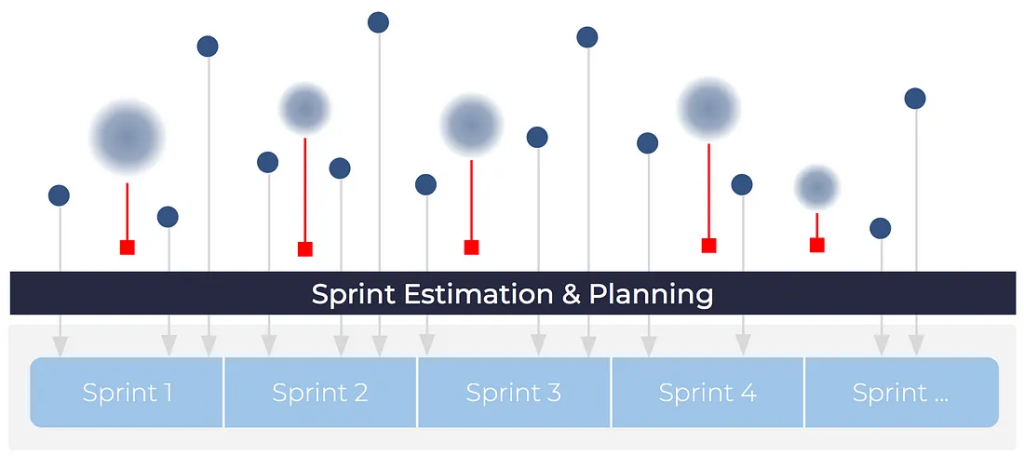
Only feed de-risked features into the Agile process

In order to keep the Agile delivery process moving efficiently, ensure that any proposed features/stories are well understood both in terms of their requirements as well as their technical complexity.

sprint estimation and planning diagram

Before ever estimating a feature, you should know:

  1. That implementing the feature will generally increase user perception of the experience
  2. The way to solve any key technical or data hurdles
  3. Confidently, how long the feature will take to build

If a feature doesn’t meet all of those criteria, then it could easily derail the predictability that is the key benefit of Agile development.

De-risking features enables teams to estimate without fear because the basic how of implementation is already well understood.

Use experimentation to connect user-centered design and Agile

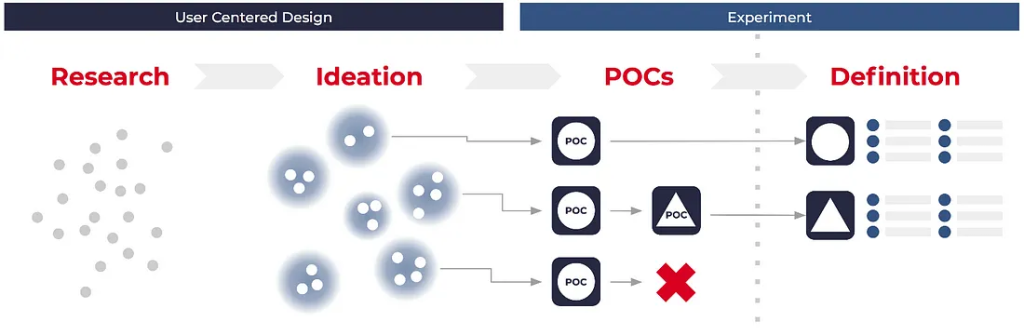
The un-vetted output of user-centered design makes it a poor input into an Agile process that works best with low risk requirements. To bridge the two, we need an intermediary process that takes fledgling ideas and systematically de-risks, prioritizes and roadmaps them at a program level.

This middle phase — experimentation — acts as the glue.

user-centered design and experimentation process diagram

Prototype, test and rapidly iterate on proof of concepts (POCs) with users to ensure that your features will have the desired impact on the user experience. These experiments provide a view into the potential ROI. By providing a clearer picture into the new experience, they also can generate investment interest at the executive level.

Similarly, technology experiments (often referred to as technical design spikes) can be used to de-risk complex technical and data problems. In this phase, the priority is not delivering a minimum viable product. Instead, the goal is taking the riskiest assumption and exploring the solution space.

At the end of experimentation, these pre-vetted features can be fully story-mapped and prioritized for delivery — the perfect input to the Agile delivery phase.

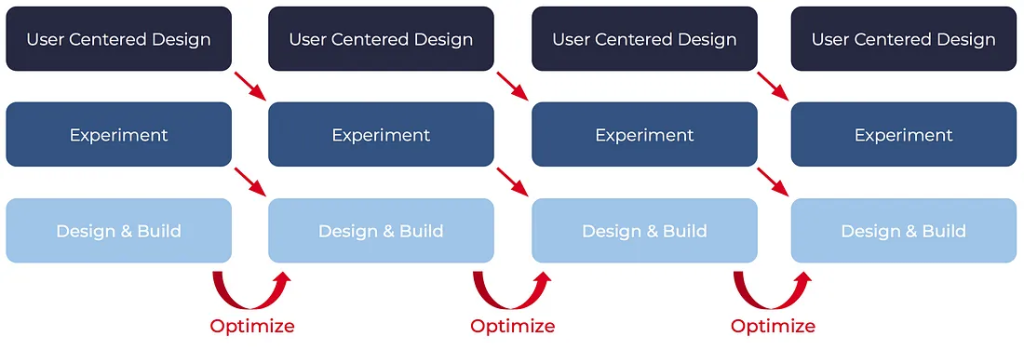
Run all three phases concurrently as an innovation program

While the experimentation phase ensures compatibility between user-centered design and Agile, it is important to note that these methods run at different speeds.

  • User-centered design takes a long time to conduct, but yields a high volume of opportunities.
  • Experimentation can be done quickly but the output may or may not produce viable results.
  • Agile generates small chunks of production-ready functionality at a regular pace.
User-centered design and innovation program diagram

To keep all processes operating at full speed, allow each of these phases to run independently and concurrently over time. Each phase generates a queue of work for the next. User-entered design creates a queue of experiments. At the same time, experimentation creates a queue of user-vetted, de-risked features for implementation.

With a never-ending list of to-dos in all three work streams, the program will operate at full efficiency. And innovative, user-centered features will flow like clockwork into your products and experiences.

Tyler Klein is the Executive Experience Director at Robots and Pencils. Physics major turned HCI specialist, he uses what’s new to build what’s next and offers far better ways to interact with the world around us. Special thanks to Chris Chew, Jamie Reid, Mike Greening, Reid Sheppard and Aaron Slepecky for their contributions.

From Chaos to Clarity: The Digital Modernization Journey

“Barely controlled chaos in a highly complex environment with fragmented innovation solutions”–that’s how one of our clients recently described their organization. I hear versions of this all the time, so if that’s how you feel, trust me–you’re not the only one! We’re in a time when adaptability and speed are make-or-break, but fragile infrastructure and fragmented data, tools, and processes keep tripping up plans. I see it over and over. It’s why digital modernization is so important.

Organizations need a stronger foundation that makes it easier to extract insights that can really make a difference to business results, to adopt new tech, and to deliver products and services at scale. But building that foundation won’t be a quick or straightforward fix. I’m talking about consolidating your current tech stack, plus introducing new implementations, integrations, and system improvements. It’s a lot! To succeed, 3 areas in particular are going to demand your attention and planning–unlocking data, improving (or replacing!) aging infrastructure, and increasing interconnectivity.

(BTW: This is blog 2 in a series on key priorities for business and tech leaders. My prior blog intros these priorities and other influential marketplace trends.)

3 Essential Elements of Digital Modernization Efforts

Unlocking hidden insights by unifying fragmented data

Most companies struggle with disconnected data and insights spread across systems and departments. When we come into an organization, we routinely find departments trying to solve problems on their own with off-the-the shelf systems (including Excel).

While everyone has good intentions, what happens is that they create tech and data silos across the organization. Eventually, a dozen disconnected applications are capturing (but not sharing!!) similar data. The other challenge many clients face is the sheer volume and complexity of data collected for personalizing customer or student experiences. Data winds up scattered across different teams, files, websites, and systems, stored in ways that are too painful to query or analyze. Yet all this powerful data is just waiting to be unleashed!

As the purse strings tighten, leaders can’t afford to leave those insights untapped or to support disparate systems. And we definitely shouldn’t be missing out on sharing valuable data across teams, where combined with the power of human creativity, new ideas can emerge. Aggregating data so that it is easily accessible is a must-do first step in practically every digital modernization journey.

Organizations need to integrate and scale solutions that work, and ditch the rest. So often I see people throwing good money after a bad solution that’s not working for their business. If you don’t have the expertise in house, find a partner who can help centralize your data and transform this goldmine of information into actionable insights.

Increasing flexibility by addressing aging infrastructure

Tech debt and aging patchwork infrastructure are a real roadblock to innovation and growth. Perhaps the problems resulted from a merger or acquisition, siloed planning, or moving fast while addressing pressing issues (like responding to shifting customer behaviors in a pandemic for example!). Whatever the cause, aging and disjointed systems are holding companies back. It’s time to address that tech debt and commit to digital modernization. Say goodbye to archaic systems in favor of more resilient, flexible infrastructure. But know that lack of clarity around ownership and the impact of system deprecation is almost certain to cause problems. To minimize issues, start by gathering and documenting this info. Having a super detailed and thorough change management plan is also vital!

(A tip from our robots: API layers can help you transition aging tech stacks. Rather than fully reengineering a tech stack from scratch, you can leverage APIs as an intermediary to create consistent access and replace the systems behind the scenes piece by piece, allowing your organization to deal with the change in more manageable chunks.)

Preparing for the future by increasing interconnectivity

One huge positive is that everyone now sees the power of connected data, systems, and “things”. Companies recognize that data surrounds everything, and that data models should be planned intentionally from the start of a project. They’re asking the right questions, like: How will we use integration to connect this data to that data? Can we use sensors to track movement of physical items? How will we ensure data integrity across systems? How do we extract those juicy insights to become a more data-led organization? I’m so glad to see leaders doing this planning up front in their digital modernization initiatives!

In some cases, I see interconnectivity extending even further as companies expose APIs to products and experiences outside their organizations. For users, this opens the door for highly curated end-to-end experiences that cut across multiple tasks and organizations. Of course, creating these experiences is not without challenges, including dealing with data and API inconsistencies. Using AI to translate data between different formats could be a game-changer, benefiting both companies and users alike. Definitely keep an eye on advancements in this area!

Coming up Next…

In future posts, I’ll explore how automation and journey-centered experiences can help with cost reduction and efficiency. Later in the series, I’ll talk about trends in personalization and engagement, plus discuss when it makes sense to seek outside expertise and guidance on your initiatives. Stay tuned!

Learn more about today’s business and tech trends — and join the discussion at an executive digital roundtable!