Robots & Pencils Appoints Jansen Meyers Senior Vice President of Operations
Robots & Pencils
New executive hire deepens the operational bench behind Robots & Pencils’ AI outcomes as the company scales its next stage of high-velocity growth.
Robots & Pencils, an applied AI engineering partner known for high-velocity delivery and measurable business outcomes, today announced Jansen Meyers as Senior Vice President of Operations. Meyers joins the executive leadership team to scale delivery capacity, sharpen operational execution, and lay the operational foundation for the company’s next phase of growth.
Meyers brings more than 25 years working with organizations to drive scalability. Most recently, he spent 16 years at Centric Consulting as a partner concentrated on operations, technology and transformation leadership, where he helped enterprise clients and Centric modernize operations and execute company-wide transformations.
“We are focused on client outcomes and accelerating everything we do for our clients. Scaling our operations requires the same emphasis,” said Nathan Carmon, Chief Operating Officer of Robots & Pencils. “Jansen simplifies the complex and designs systems that let exceptional people maintain their focus on outcomes and acceleration, not internal work and systems.”
In his new role, Meyers will oversee internal operations, expand delivery capacity, and engineer the operational backbone behind every Robots & Pencils engagement, the systems that let Velocity Pods take generative and agentic AI live in weeks, not quarters. His leadership will help the company scale with the same agility, craft, and client focus that have defined the company since it was founded in 2009.
“Complexity is easy; efficiency is deliberate. My focus is eliminating drag, so the business moves as fast as its ideas,” said Meyers. “The people here already move like they have done this before. My job is to make sure the processes and systems never get in their way.”
Meyers joins Robots & Pencils as more organizations turn to the company to move generative and agentic AI from pilot to live. His appointment reflects continued investment in the leadership and operational depth behind Robots & Pencils’ AWS Advanced Tier Services Partner and AWS Pattern Partner status, and its record of measurable business outcomes across 175+ clients worldwide.
RoboCon 26: How Robots & Pencils Turned a Spark into a Surge
Christina Morello
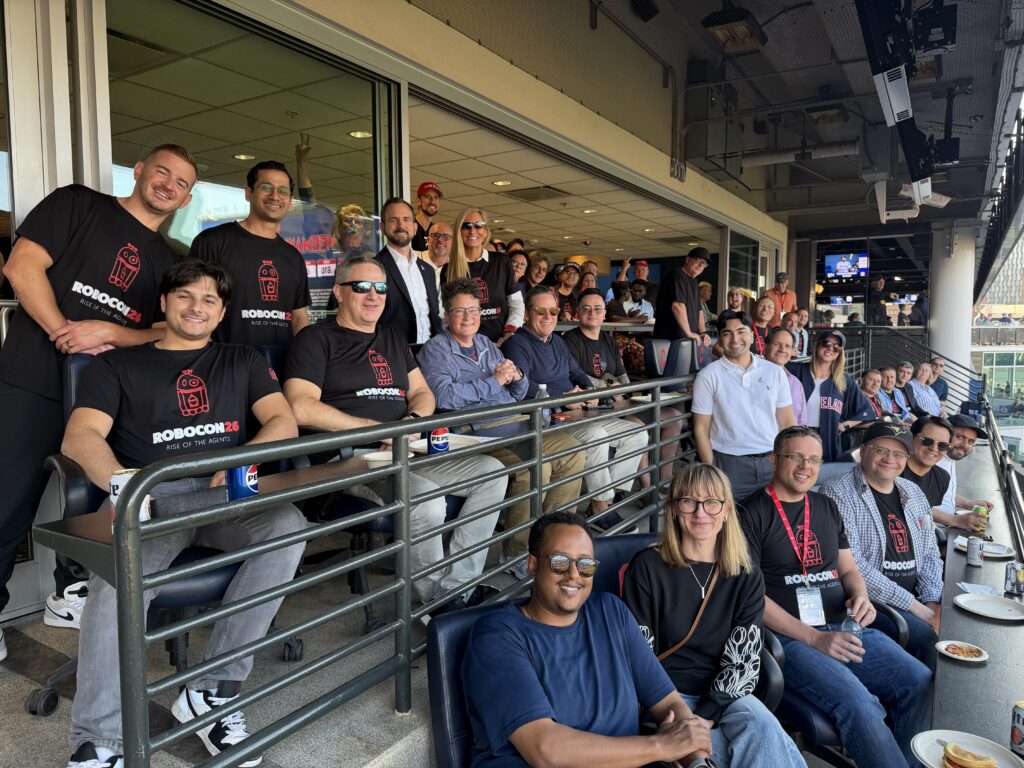
A fire needs three things: something to strike it, something to feed it, and something worth burning for. Robots & Pencils spent six weeks on the first, three days in a Cleveland skyscraper on the second, and it’s building the third right now. We call the whole arc RoboCon 2026: Rise of the Agents, and if you were anywhere near downtown Cleveland the week of July 21st, you felt it.
This is the first of many stories we’ll tell about what happened here. Before we get to the pods, the points, and the people who pulled all-nighters, it’s worth answering the plain questions. Who did this, what actually happened, when, where, and why any of it mattered. Three phases carry that story: Spark lit the competition; Ignite brought it together in Cleveland, and Surge is the follow-through happening right now.
What is RoboCon?
RoboCon 26 is Robots & Pencils’ internal AI competition, built to transform how we work with our clients and each other. Our CEO Len Pagon kicked things off on June 12th with 56 leaders from across the company.
“Most companies are still figuring out how to start. We are already doing it. We design the architecture that takes AI from a demo into the actual work of the business. That is harder than it sounds. Most cannot. We can and we do.”
That gap, between demoing AI and actually running a business on it, is the whole reason RoboCon exists. Pagon had the data to prove it, a six-level AI proficiency ladder gleaned from usage and a proprietary assessment tool. It showed exactly how and where the company could accelerate and codify its generative and agentic AI capabilities across every single current and future employee. “The pace is fast because the window is now,” Pagon told the room, “not next quarter, not another planning cycle.”
So he picked roughly a quarter of the company, the leaders who could carry the change back to their teams, split them into seven pods of about eight people each, and told them to compete.
Spark: The Competition
Spark ran six weekly challenges, and each one moved the pods a step further down the same road: start by setting a shared culture baseline in the newly written Pencil Way, then build something real with the tools, then improve it, then apply it to actual client work. Partway through the six weeks, the competition stopped belonging only to the seven pods. Spark opened up to the whole company, a cohort of allies, and the job was to mentor them through the similar tasks the pod had already worked through. Their learning and their work counted toward their pod’s score. One rule sat above all the scoring: “Client work comes first,” Pagon told everyone. “That if you ever have to choose between working for our client, or you got to do this challenge, the client comes first…always!”
Ignite: Three Days in Cleveland
Six weeks of remote sprinting funneled into three days in person, July 21st through 23rd. Jeff Kirk, EVP of Applied AI, set the tone once everyone was on site.
“It’s time to get into ultra-learning mode,” he said. “To work backwards from our most important customer outcomes and continue to incorporate AI agents into our professional services motion.” He pushed the room toward something harder than a workshop agenda. “Use radical candor with your colleagues and solve some of the most critical challenges that we’re facing on a day-to-day basis as we innovate on behalf of our clients – we transfer our know-how to our clients as a result of Robots & Pencils working with them.”
The three days played out exactly that tension between celebration and work. A championship reception opened things on July 21st, in Pagon’s own backyard. The next two days filled Key Tower’s meeting rooms with keynotes, breakout sessions, and afternoon hackathons, where seven pods turned six weeks of practice into something they could stand behind. Stay tuned for individual and pod stories.
Time for hot dogs, a ball game, and each other.
Surge: Bringing it Home
It would be easy to read Ignite as the climax of the story. It was the culmination of Spark, no question. But Pagon frames it as the first 2 phases as preparation for the most important phase, not an ending. Ignite closed with a personal commitment from every participant: one shift they were making, a few ideas for their team, and a 30, 60, and 90-day plan to make it stick. Read a handful of them back-to-back and the range says more about Surge than any recap could.
“RoboCon reinforced something for me,” said Kristy Andersen, senior delivery manager. “Individual AI fluency is the floor. Organizational AI capability is where things accelerate and impact compounds.”
Pagon called RoboCon an investment in our people and the company, the kind that doesn’t pay off in three days. It pays off in what people do with what they learned once the reception ends and the ballgame’s over. That work is Surge. It’s already underway, and it’s the story we’ll keep telling from here.
NO REGRET, Part Two: The LEARN Phase Agentic AI Playbook for Holiday 2026
Saul Delage
A few weeks ago, I made the case that the Learn and Use phases of the shopping journey are the no-regret bets for Holiday 2026. Consumer readiness is proven, the ROI compounds regardless of pace, and the 90-day window between July 1st and the pending holiday code-freeze in October is enough time to deploy to production. That argument still holds. What it did not have was a scorecard.
Now it does. Last week (July 15), ReFiBuy and Digital Commerce 360 published their inaugural AI Commerce Rankings, a quarterly benchmark that scores the Top 1000 retailers 0 to 100 on how ready their product catalogs are for AI shopping agents to read, interpret, and recommend. It is the first hard measurement of Learn phase readiness at scale, and it confirms both halves of the no-regret argument at once. The opportunity is real. Almost nobody has captured it yet.
The Diagnosis: 42 Out of 100
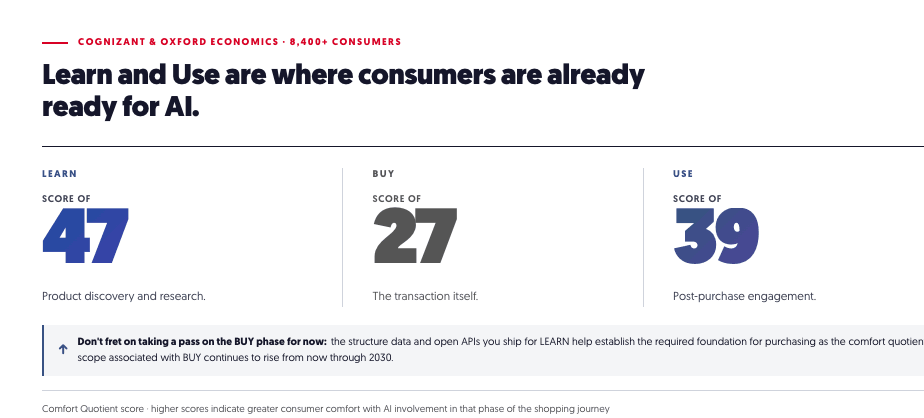
Cognizant’s Comfort Quotient research, which I cited last time, put Learn phase comfort at 47, the highest of the three purchase phases, with Early Adopters and Accelerators scoring 58 and 50 respectively. Consumers are ready. The AI Commerce Rankings show what retailers have built to meet them there. The average score across all 1,000 retailers is 42, with a median of 44.1. Only 20 retailers score above 60. The highest score recorded, out of 1,000 of the largest retailers in the country, is 72.
Scale does not buy readiness. Online Labels ranks #1 on AI readiness with a score of 71.8 and sits at #814 by online sales. Everlane ranks #4 in readiness at #264 by sales. Several of the retailers with the largest online sales volumes in the country rank in the bottom half of the readiness index. The retailers most exposed to AI-driven discovery traffic today are, in some cases, the ones AI agents can least see. Deloitte’s Stephan Ritter put a finer point on it recently on the Retailgentic podcast: most products will never be seen by AI, because most catalogs weren’t built for AI to see them.
There’s a concentration risk layered on top. ChatGPT accounts for more than 80% of AI-referred traffic to retail sites right now. Adobe Analytics clocked 693% year-over-year growth in generative AI traffic during Holiday 2025, then 393% year-over-year growth in AI-source traffic in Q1 2026. That traffic is real, it is growing fast, and most of it is flowing through a single door.
What to Build in the Next 90 Days
The Learn phase playbook is not a strategy exercise. The AI Commerce Rankings methodology is, in effect, a build spec. It scores exactly what an AI shopping agent experiences when it hits your catalog.
Bot friendliness first. Can ChatGPT, Gemini, and Alexa for Shopping actually reach, read, and transact against your product data, including support for emerging agentic commerce protocols like UCP and ACP? Only 26% of retailers in the index have verified UCP status. That’s the single highest-leverage fix available in the next 90 days for most retail IT teams, and it’s an engineering problem, not a marketing one.
Second, build for more than one engine. A single-engine dependency on ChatGPT is a single point of failure the moment a competing model changes its retrieval behavior or a new entrant like Perplexity gains share. Diversity of AI sources is one of the four signals the rankings measure for a reason.
Third, treat product content as multimodal infrastructure, not marketing copy. Cognizant’s research is direct about this: businesses will need multimodal approaches to conveying product and service information as AI-powered discovery becomes the default research path. That means structured attributes, image and video content agents can parse, and the metadata layer that turns a SKU into something an agent can reason about.
Fourth, know where your category actually sits. The rankings break out readiness by category, and the spread is wide. Office Supplies leads at 47.4. Food & Beverage trails at 37.2, the lowest score and the lowest AI traffic penetration in the index, in a category that touches nearly every consumer every week. One top-10 retailer by online sales in that category ranks below #550 on AI readiness. For CPG and grocery brands, that gap isn’t a warning. It’s the opening.
The Infrastructure Argument Hasn’t Changed
None of this ships from a slide deck and a vendor demo. It requires the same technical foundation I described in the first piece: unified product data, a semantic layer that lets an agent reason across your catalog instead of guessing, and guardrails that keep that reasoning inside the lines. AWS makes the case plainly in its own executive guidance on agentic AI. Organizations that have already operationalized generative AI with production-grade rigor, on a foundation like Amazon Bedrock, are the ones positioned to turn isolated catalog pilots into governed, reusable capability instead of another one-off integration.
That’s applied engineering work, not a repositioning exercise. It’s also the same discipline we walked through recently in how a marketing function runs on Amazon Quick with generative and agentic AI: real data, real guardrails, real production deployment. That’s what separates a working system from a slide.
90 Days, One Scorecard
The October constraints haven’t moved. The pending holiday code-freezes still lock down the production environments for most retailers and consumer brands ahead of peak season, and Amazon’s Fall Prime Event still opens the early holiday promotional calendar in early/mid-October (exact dates still pending, which makes preparation for brands even more challenging). What’s changed is that there’s now a public, quarterly, refreshed scorecard measuring exactly which retailers used this window and which ones didn’t.
An average score of 42 means the race is still open. Twenty retailers have separated from the pack. The other 980 have less than 90 days to decide which side of that line they land on before the next edition publishes.
Almost every retail and consumer goods brand I speak with agrees the opportunity is real. The AI Commerce Rankings just gave everyone a number to measure it against. If your team wants to know where your catalog stands and what to fix first, I’d like to be part of that conversation. Reach out on LinkedIn or directly.
Next up: the Use phase, and what “taking care of itself” actually means in production.
Saul Delage is SVP Client Partner at Robots & Pencils, focused on the Retail and Consumer Goods vertical. Robots & Pencils is an applied AI engineering partner, all in on AWS.Connect with Saul.
The Robots & Pencils’ Talent Perspective: What Recruiters Look for in a Resume
Madeleine Barthelmess
Robots & Pencils’ Head of Talent, Madeleine Barthelmess, breaks down what recruiters actually need from a modern resume, and where the real story is getting lost.
I hear this almost every week. Someone tells me they’ve applied to hundreds of jobs, heard nothing back, and blamed the ATS. Maybe you’ve said something similar yourself. My resume never reached a human. The AI rejected me. If only I had the right keywords. As Head of Talent at Robots & Pencils, I read resumes for a living, and here’s what might surprise you. Most resumes aren’t rejected because of AI. They’re rejected because they don’t tell a compelling story.
Here’s the short version. AI isn’t deciding who gets hired. People are. Yes, we use applicant tracking systems. Yes, technology helps me process thousands of applications. But I still open the file. I still read the first few lines. I still make the call. If your resume isn’t landing interviews, the fix isn’t a new set of keywords. It’s a better story.
The 75 Percent Myth Has No Study Behind It
I’ve spoken to candidates who have applied to 500 jobs, even 1,000. Then I ask one question. How many interviews have you gotten? Usually the answer is somewhere between zero and five. That tells me the problem isn’t the ATS. The problem is strategy.
The claim that three out of four resumes get auto-rejected before a human ever sees them shows up everywhere, from career coaches to LinkedIn posts. It traces back to a 2012 marketing claim from a resume-optimization company that went out of business the following year, not a peer-reviewed study or an industry survey. I use applicant tracking systems every day, and what they actually do is organize and rank applications. They don’t run a silent purge on formatting or keyword scores alone.
That distinction matters more than it sounds. If you believe your resume vanished into a black box, you’ll keep tweaking keywords. If you understand that a person like me is going to open that file, you’ll start writing for that person.
Your Resume Is a Marketing Document, Not a Biography
Here’s something I wish every job seeker understood. Your resume is not your biography. It’s not supposed to document every job you’ve ever had. Think about Apple. When Apple launches a new product, they don’t spend an hour talking about every device they’ve ever built. They focus on what matters to today’s customer. Your resume should do exactly the same thing. Every line should answer the same question. Why should I interview you for this role? If something doesn’t help answer that, it probably doesn’t belong there.
One mistake I see constantly is candidates trying to include everything. Every internship, every volunteer project, every certification they’ve ever earned. More information doesn’t make your resume stronger. Relevant information does. I’d rather review one focused page than three pages filled with information that has nothing to do with the role you’re applying for.
What Recruiters Scan for in the First Few Seconds
I don’t spend minutes carefully reading every resume, at least not at first. I’m scanning for clarity. An eye-tracking study conducted for TheLadders found recruiters spend roughly six to eight seconds on that initial scan, and more recent research puts the number closer to eleven. Either way, I have seconds, not minutes, to find three things.
Can I immediately understand who you are?
Can I see what value you bring?
Can I quickly connect your experience to the position I’m hiring for?
If I have to work too hard to figure that out, you’ve already made the process harder for both of us. When you’re competing with hundreds of other applicants, clarity becomes your biggest advantage.
Where AI Actually Belongs in Your Job Search
Can ChatGPT help you write your resume? Absolutely. Should it write your entire resume? Absolutely not. AI is an incredible assistant. It can help identify important skills, rewrite bullet points, improve grammar, and organize your ideas. But it shouldn’t replace your own voice. The more resumes I read, the easier it becomes to recognize the ones written almost entirely by AI, not because they’re bad, but because they all sound the same. Everyone is using AI to try to stand out, and they’re accidentally making themselves sound identical. Ironically, the candidates who actually stand out are the ones who use AI as an editor, not as the author. Your story still has to sound like you.
Your Resume’s Real Job
If there’s one thing I want you to remember, it’s this. Your resume doesn’t get you hired. It gets you a conversation. That’s its job. So stop trying to outsmart AI. Stop trying to game the ATS. Instead, write a resume that makes it easy for another human being to understand who you are and why you’re the right person for the role. No matter how much the tools change, one thing hasn’t changed. People still hire people.
I go deeper on all of this in the full episode above, including the exact professional summary line I want every job seeker to delete immediately.
Does AI reject resumes before a recruiter sees them?
No. I use applicant tracking systems to rank and organize applications, not to reject them silently. I’m the one making the hiring decision, not the algorithm.
Why do I keep getting rejected after applying to hundreds of jobs?
Usually it’s strategy, not the ATS. I’ve talked to candidates who applied to 1,000 jobs and got five interviews. Applying broadly without tailoring your resume to each role’s actual requirements produces a high application count and a low interview count.
Should I use ChatGPT to write my resume?
Use it to edit, not to author. I can tell almost immediately when a resume was written entirely by AI, and not because it’s bad. It’s because it sounds like everyone else’s. Let AI tighten your bullet points. Don’t let it replace your voice.
What should a professional summary actually say?
Skip “seeking an opportunity to utilize my skills.” I already know your objective is the job. Use the summary to tell me who you are, what problems you solve, and what you’re known for.
Two trades, one person, the character in the middle.
Twenty years ago a parent told their kid not to major in art. Ten years ago they said it about English. Five years ago the script tightened to anything that didn’t end in -ology or -engineering. STEM was the moat. STEM was the parachute. STEM was the answer to every dinner-table question your kid was too polite to ask out loud.
You know how this ends.
I’ve been watching it end in slow motion for eighteen months. The CS grads I talk to are anxious in a way the comp lit grads aren’t. Not because the comp lit grads have it figured out. They don’t. Nobody does. But they were never promised the floor wouldn’t move. The CS grads were told it was bedrock. Then somebody started writing code at the speed of thought, and the bedrock turned out to be a Jenga tower with a six-week release cycle.
The irony is thick enough to spread on toast. We trained a generation to speak the language of machines. The machines turned around and learned the language of people. If a screenwriter pitched that arc, the room would tell them to dial it back.
The company whose name explained everything
I want to tell you a story about a company I ran, because I think it explains what’s actually happening, and what’s coming for the people who were paying attention.
In 2014, I brought a Canadian agency called Robots & Pencils down to the States. I was CEO of the US operation. We grew thirty-four hundred percent in eighteen months, finished the year as the 35th fastest-growing tech company in the country, and most of the press I gave at the time was about the numbers. The numbers weren’t the story. The name was.
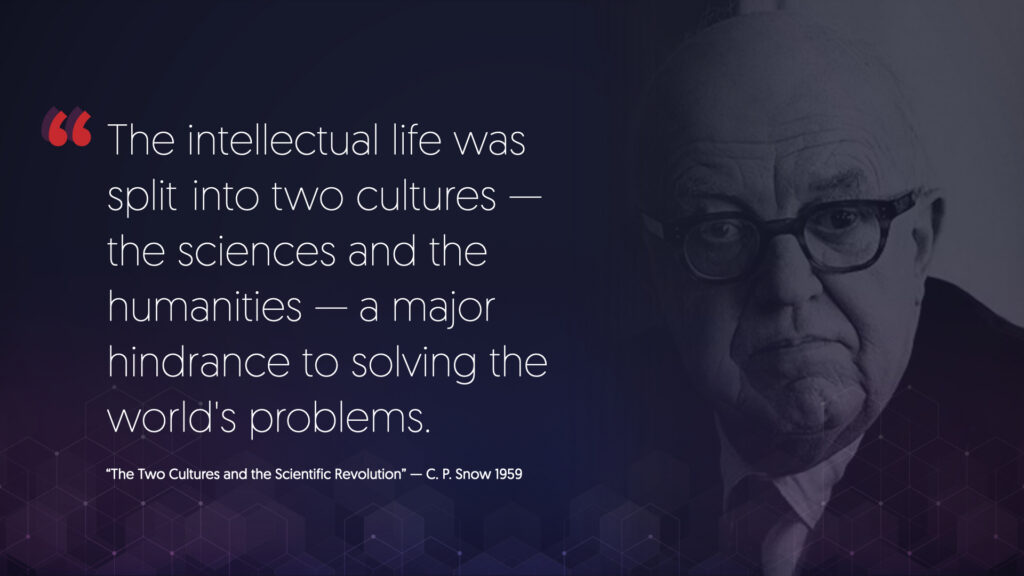
Robots & Pencils. The name was lifted, more or less, from C.P. Snow’s 1959 lecture on the Two Cultures. Snow’s argument that the sciences and the humanities had drifted into separate languages that could no longer talk to each other, and that the gap between them was the central problem of modern life. He wrote it about Cambridge dining halls. We built it as an agency.
The robots were the developers. People who could build the thing. The pencils were the designers. People who could see the thing before it existed. Two trades, two trainings, two languages, two halves of any product worth shipping. We had robots. We had pencils. We were good at both.
And the founder, who was (ironically, beautifully, to his own ongoing amusement) robot #1, was the most insistent voice in the building that good products are always visioned pencils first. You can’t bolt art on at the end. Try it and the seams show forever. The most technical man in the room kept telling the room to start with the drawing.
Two people who were already the bridge
He didn’t found the company alone. His wife was the pencil to his robot, a brilliant artist, an interior designer with the eye that finds the wrong wall and tells you why, an accountant sharp enough to serve as the company’s CFO. He was the technical man with a love of art he couldn’t fake. She was the artist with the operational backbone most companies wish they could hire. Each of them stretched toward the center. Each of them was already half ampersand before the company had a name.
That’s why it worked. The two people at the top of the org chart were the bridge they were asking the rest of us to build. You felt it the second you walked in. It pulled in robots who suspected they were also a little bit pencil, pencils who knew they were also a little bit robot, and the people who’d never picked a side at all. The brand wasn’t a logo. The brand was the marriage.
But the ampersand was the entire reason the company existed.
The rarest person in any room
You know who I mean. The dev who notices the kerning. The designer who reads the API docs because she actually wants to know what’s possible. The one who drops #picky into a Slack design review without apologizing for it, because they know the small thing is the whole thing. The person who can sit between two rooms that don’t speak each other’s language and translate. Not the words. The intent. They were rare. We’d interview a hundred people and find one. They commanded a premium because the value of a translator scales with the distance between the parties, and the distance between an engineer and a designer in most companies is bigger than the distance between Calgary and the moon.
The ampersand people weren’t better at either trade. They were the only ones in the room who saw both trades as the same problem from different chairs. They were almost mythological. We named the company after them.
What AI actually does for the bridge person
Here is what I didn’t see coming, even though I should have. AI doesn’t pick a side. It never had to. It doesn’t just close the gap between the dev and the designer. It closes the gap inside the bridge person, the small and humiliating gap between what they could always see and what they could actually produce. The designer who knew exactly how the API should work but couldn’t write the call. She can write the call now. The dev who saw the right pixel grid but couldn’t move pixels. He can move pixels now. The ampersand always saw both ends of the bridge. Now they can walk it. If Jobs called the computer a bicycle for the mind, AI just strapped rocket engines to the sides.
You want proof? A 23-year-old amateur mathematician named Liam Price, no PhD, no faculty appointment, no research lab, used ChatGPT to solve an open problem that had been sitting on the shelf for sixty years. Erdős Problem #1196, from primitive set theory. Sixty years. The kind of problem that gets named after the person who posed it because nobody alive could finish it. Price finished it. And then Terence Tao, the Fields Medalist, the person most mathematicians would rank as the best living mind in the discipline, verified the proof and co-authored the resulting paper. A 23-year-old with curiosity and a chatbot sat down at the same table as the greatest mathematician of his generation. Not because AI solved the problem for him. Because AI let him hold the conversation long enough to solve it himself. That’s the ampersand. That’s curiosity with tooling that doesn’t punish you for not having the right letters after your name.
The bridge people are about to multiply. Not because the trait gets more common. That takes generations, and curiosity in two directions has never been on any roadmap I’ve ever seen. But the trait finally has tooling that doesn’t punish it for refusing to specialize. For thirty years we paid the ampersand person less because they weren’t “really” a developer or “really” a designer. We tolerated them because they made the meetings work. They are about to inherit the building.
And the lesson runs wider than design and code, because the ampersand was never really about design and code. The ampersand is about being curious in two directions at once. It’s about being the kind of person who refuses to pick a side because they can’t stand to leave the other side ignorant. That’s not a job description. That’s a humanities education.
Read carefully. Argue clearly. Hold a contradiction without flinching. Care about the answer even when nobody’s grading you. Do the hard thing quietly. Take care of the person next to you before you take care of yourself. Carry two trades at once and a third in reserve. Say what you mean and mean what you say. It doesn’t sound like much. It also doesn’t fit in a job code, which is why we’ve been quietly defunding it for forty years. It didn’t return on a single-year horizon, and the only people who tried to defend it sounded like they were defending themselves.
I’ll tell you where I learned all of it, because it wasn’t school. It was my parents and the people they surrounded us with. A father who came up through the Green Berets and ran a house on the principle that you say what you mean and you mean what you say. A mother and a community who treated curiosity as a chore you didn’t get to skip. Nobody handed me a syllabus on holding a contradiction. I watched the adults around me do it at the dinner table. I graduated into the internet in 1985 and was running an ISP a decade later. That sharpened the tools. The tools came from home.
That’s the part the system can’t replicate and won’t admit. The ampersand is mostly raised, not taught. The people who saw this moment coming were mostly the ones we wouldn’t fund. And the ones who can step into it now were mostly raised by people who didn’t need a funding line to know it mattered.
The skill with a 25-year half-life
Framework knowledge has a half-life of about two and a half years. That’s IBM’s number for specialist technical skills, and it tracks with what the National Academy of Engineering has been saying for twenty years. By contrast, the half-life of a humanities education runs closer to twenty-five. The argument structure Aristotle taught is still the argument structure that wins. The people who can build and fix the machine will be needed for as long as there’s a machine. The play isn’t picking a side. It’s picking one discipline that ages well and one that compounds fast, and refusing to let either atrophy.
Walk into a room where the pencils and the robots are really cooking and you can feel it through the floor. The designers sketch faster than the engineers can build. The engineers build faster than the designers can sketch. The ampersand is at the whiteboard turning the sketch into a system and the system into a sketch, and everybody in the room is operating one cognitive notch above where they could operate alone. That hum used to be the rarest sound in tech. We’re about to hear it everywhere. In classrooms, in clinics, in non-profits, in offices that have been quietly dying for a decade because the bridge person never showed up.
Don’t mistake this for triumphalism. The reversal doesn’t make the humanities grad rich and the CS grad poor. It rearranges who has leverage, which is a different and harder problem. The CS grads who pair their craft with the human stuff, curiosity in two directions, care for the person on the other side of the screen, are going to be fine. The humanities grads who learned to type sentences but never learned to sit with a real problem until it broke? They’re going to wash out the same as anyone. The credential never saved anybody. The skill underneath the credential is the only thing that matters now.
What’s coming is a world where you need both hands. The robot hand and the pencil hand. The technical and the human. The thing the machine can amplify and the thing the machine cannot replace. People who learned only one are about to find themselves doing half a job. People who learned both, the ampersands, the bridge people, the curious-in-two-directions people, are about to find the assignment finally suits them.
The career advice parents need to hear in 2026
I’ll say something with an edge, because I have watched too many parents push too many kids in the wrong direction and I am out of polite ways to put it. Stop telling your daughter to pick something “practical.” There is nothing practical about training her for a job description that will be rewritten before she graduates. Tell her to chase the thing she is actually curious about, and tell her to learn the tools that scale curiosity. That is the practical answer in 2026. Everything else is nostalgia for a stability that was always a marketing slogan.
And tell her to find the room. Find a university, a community, a circle that’s already wired for curiosity in two directions. Humanities and sciences sitting at the same table, AI amplifying both, and credentials that still translate into workforce currency on the other side. Skills, capabilities, and a degree. Not one or the other. Humble plug, because it would be dishonest not to say it: that’s exactly what we’re building at Maryville. An achievement architecture for all of them. Robots, ampersands, and pencils. AI amplifying each one’s curiosity and capabilities. We’re about to show, not tell, what that means. Stay tuned.
The ampersand was always the symbol of the company because it was the symbol of the work. Two trades, one person, one connector character holding the whole sentence together. It was never decoration. It was the structure.
The robots are getting better. The pencils are getting better. But the people who can hold both, who can be technical without losing their humanity, who can be human without abandoning the craft, those people are about to inherit the moment. The ones we underpaid for thirty years because we couldn’t fit them in a column.
Strive to be a little ampersand. Not just the robot. Not just the pencil. The character in the middle that connects them.
That’s the job now. And it’s the abstract of every job that comes after it.
The team Phil wrote about? That’s us. Robots & Pencils has been building at the intersection of technical and human since day one. Request an AI briefing and see what that means for your organization.
About Phil Komarny
Phil Komarny, an award-winning executive, national thought leader, and Chief Future/AI Officer at Maryville University. He led Robots & Pencils as CEO in 2014 and 2015. It’s clear he never stopped thinking about what our name meant.Read more articles by Phil.
Key Takeaways
The “ampersand person” is someone curious in two directions at once — technical and human — and they have always been the most valuable person in the room.
AI doesn’t replace the bridge person. It closes the gap between what they could always see and what they could actually produce.
Framework knowledge has a half-life of roughly two and a half years. The skills underneath a humanities education run closer to twenty-five.
For thirty years we underpaid the generalist because they didn’t fit a job code. That’s about to change.
The practical career move in 2026 is pairing one discipline that ages well with one that compounds fast — and refusing to let either atrophy.
FAQ
What is the ampersand person? Someone who refuses to specialize in just one direction. They can sit between two rooms that don’t speak each other’s language and translate not the words, but the intent.
Why is the Robots & Pencils name significant? The name draws on C.P. Snow’s 1959 Two Cultures lecture — the idea that the sciences and humanities had drifted into separate languages. Robots represented the builders. Pencils represented the visionaries. The ampersand between them was always the point.
How does AI change things for generalists? AI closes the gap between what bridge people could always see and what they could actually produce. The designer who knew how the API should work can now write the call. The developer who saw the right pixel grid can now move pixels.
Is a humanities education still worth it? According to Phil Komarny, yes — more than ever. The argument structure Aristotle taught still wins. The credential doesn’t save anyone, but the skill underneath it compounds in a way technical specialization alone no longer does.
What should parents tell their kids about careers in an AI world? Stop pushing “something practical” defined by yesterday’s job market. Tell them to chase what they’re genuinely curious about and learn the tools that scale curiosity. That is the practical answer in 2026.
The NO REGRET Agentic AI Focus Area for all Retailers and Consumer Brands this Holiday Season
Saul Delage
By Saul Delage – SVP Client Partner, Robots & Pencils
July 1st has already come and gone. For most retailers and consumer brands, that date signals the final 90-day window to deploy new capabilities for Holiday 2026. By mid-October, most retail IT environments will be in code freeze. Amazon’s Fall Prime Event (Prime Big Deal Days) will have already kicked off the early holiday promotional season.
Where Consumers Are Already Ready for AI in Retail
Cognizant’s research, conducted with Oxford Economics across more than 8,400 consumers, maps AI comfort across three phases of the shopping journey using a Comfort Quotient score: Learn (product discovery and research), Buy (the transaction), and Use (post-purchase engagement).
The Learn and Use phases are where consumer AI comfort is meaningfully established today. These represent the majority of your shoppers’ journey, not edge cases. And the market data confirms it’s already happening at scale. At Citi’s Global Consumer and Retail Conference in March, Jason Goldberg and Scot Wingo reported that Target saw 40% month-over-month traffic growth attributed to AI discovery tools like ChatGPT and Gemini. Amazon’s AI assistant Alexa for Shopping (formerly Rufus) is now engaging 300 million users. These are current numbers. The Learn phase is where AI is already reshaping how consumers find products, right now.
The Use phase tells a complementary story. Consumers respond positively to products and services that “take care of themselves” — post-purchase support, order tracking, repurchase reminders, personalized engagement after the sale. The Comfort Quotient rebounds to 39 in this phase, including among consumers who are otherwise skeptical of AI. That’s a meaningful signal for where agentic AI delivers value with low resistance.
These two phases are the no-regret focus areas. The case for building here is non-debatable: consumer readiness is established, the use cases are proven, and the ROI accrues at every stage of adoption growth.
Why the Holiday Season Makes These AI Comfort Phases the Right Bet
Holiday 2026 amplifies exactly the dynamics where AI in the Learn and Use phases delivers the most value.
Discovery is highest-stakes in Q4. Consumers are actively searching for gift ideas, comparing unfamiliar products, and making purchase decisions outside their normal categories. AI-powered search, personalized recommendations, and multimodal product content are at peak value when the shopper is motivated but undecided. Convenience, which Cognizant’s research confirms as the primary driver of AI adoption ahead of price, matters most when a consumer is under time pressure. That’s November and December.
Post-purchase is highest-volume in Q4. Order tracking inquiries, gift returns, product questions, and repeat purchase decisions all spike in November and December. Agentic AI deployed in the Use phase handles that volume, reduces service load, and turns a high-friction season into a loyalty-building moment. The brands that get this right in Holiday 2026 build the customer relationships that pay forward into 2027.
Both phases can be scoped, built, tested, and deployed within the 90-day window between July 1 and October. They are where consumer readiness is highest, return is fastest, and the path to production is most straightforward.
The AI Infrastructure Layer That Makes Next Holiday Season Even Better
There’s a second dimension to the no-regret case, running on a slightly longer timeline.
Cognizant’s research maps a third wave of change arriving by 2030: agentic purchasing, where consumer AI agents interact directly with business AI agents to orchestrate the full shopping journey. Goldberg and Wingo noted at Citi’s Global Consumer & Retail Conference that Google and OpenAI are already establishing the protocols for this — structured data standards, API interoperability, and checkout orchestration that will determine which brands surface when consumer AI agents start driving discovery decisions.
The infrastructure that enables agentic commerce is the same infrastructure that improves Learn phase performance today: structured product data, external-facing APIs, and the connective tissue that lets your catalog show up wherever consumers are searching, whether that’s a search engine, a voice assistant, or an AI agent acting on a consumer’s behalf.
Building this foundation now is a no-regret bet precisely because it pays off at every stage. It improves holiday 2026 performance. It positions the brand for the agentic commerce era as adoption accelerates. It is additive regardless of pace.
October brings two converging constraints: IT freezes lock down most retail environments ahead of peak season, and Amazon’s Fall Prime Event kicks off the early holiday promotional calendar in mid-October. The brands that have agentic AI capabilities in production for Holiday 2026 are the ones starting the work in the next few weeks, not in September.
Almost every retail and consumer goods brand I speak with shares the same conviction: the opportunity is clear, the consumer readiness data is unambiguous, and the timing is right. The constraint is activation. How to get AI from conviction to something in production in a compressed window.
That’s the work we do at Robots & Pencils. If your team is ready to move in the next 90 days, I’d like to be part of the conversation. Reach out on LinkedIn or directly.
Progress beats paralysis, and in retail, the calendar is the most unforgiving proof of that.
Saul Delage is SVP Client Partner at Robots & Pencils, focused on the Retail and Consumer Goods vertical. Robots & Pencils is an applied AI engineering partner, all in on AWS.