
Heard us on
The AI Daily Brief Podcast?

Heard us on The AI Daily Brief Podcast? For AI, we're all in on AWS. Let's build AI teammates for your enterprise.

Pt. 2: Repo-Native Delivery – The Operating Model 

Part 2 of 2. Part 1 made the case for moving delivery out of Jira and into the repo. This is the how, concrete enough to copy. 

In Part 1, I argued that a tracker quietly makes humans the integration layer, and that moving delivery artifacts into the repo hands much of that assembly work to the tooling. 

This is the operating model that fell out of that idea. 

The goal is simple: 

Every artifact should be readable by both a human and an assistant without translation. 

Stories, decisions, sprint history, status updates, technical plans, reports: all of it lives in a form that the team can read directly and that an assistant can traverse without APIs, connectors, or synchronization. 

None of this is exotic. It’s markdown files, Git, and an agent-aware editor like Cursor or Claude Code. 

The discipline is what makes it work. 

Two repos, two rhythms 

The first decision is to stop forcing artifacts and code to share a history. 

They have different cadences, different gates, and different owners. 

So they get different repos. 

The delivery repo holds artifacts only: stories, sprints, decisions, context, prompts, and reports. 

The code repos stay exactly as they should be: feature branches, pull requests, CI, and release workflows. 

Each code repo’s CLAUDE.md points back to the delivery repo so that any assistant reading the code also has access to the project’s intent and decisions. 

That separation solves a surprisingly common problem. 

Trackers go stale because updating them competes with shipping code. When artifacts live in their own frictionless repo, there is nothing competing for attention. A decision or status update takes seconds to commit and lands immediately. 
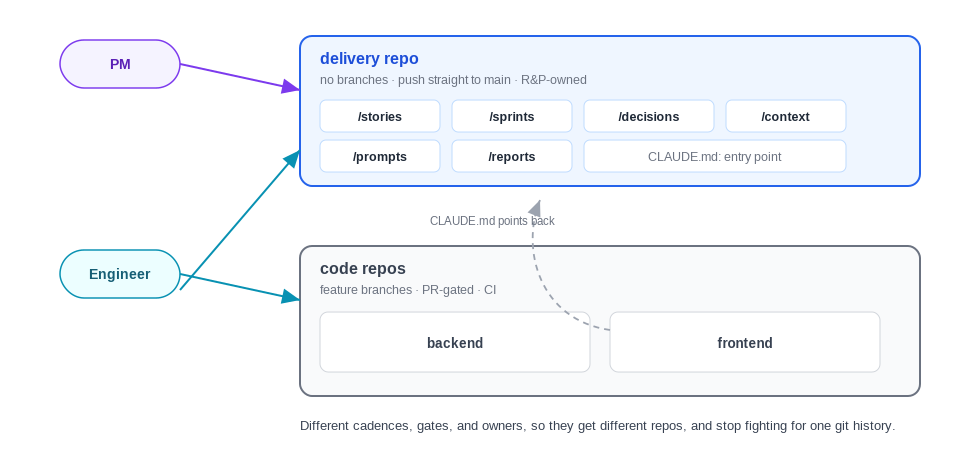
Delivery repo (no branches, push to main) holds the artifacts; code repos stay feature-branched and PR-gated and point back via CLAUDE.md. 

No connector, no second system 

There is no tracker and no connector. 

The files are the context. The same editor the engineer uses to build is where the assistant reads stories, specifications, decisions, and status. 

That is also why this is a team model rather than a PM productivity hack. 

Managing a project through a Jira connector is something one person does from their own AI session. Here, everyone works from the same source. Engineers build from it. Designers contribute to it. Reports generate from it. 

Nobody waits for a board to catch up. 

The story is a directory, not a ticket 

Our unit of work is a folder, not a line item. 

A story directory holds a few files, each with one job: 

File What it holds 
story.md The contract 
technical-spec.md The plan 
grooming.md The conversation and rationale 
status.md Current state and progress 
decisions/, artifacts/ Evidence and story-scoped decisions 

Together they form the work surface. 

When an engineer opens a story, the assistant sees the same picture they do: the requirements, the implementation plan, prior decisions, open questions, and evidence. 

Dependencies are recorded as simple wikilinks such as [[E2-1]], giving assistants a graph they can traverse rather than a collection of disconnected tickets. 

For engineers: a control plane, not PM docs in Git 

It would be easy to read all of this as project managers moving their paperwork into Git. That is not what it is. 

For an engineer, the repo turns delivery artifacts into part of the work surface, instead of a parallel system to keep in sync. 

Start with the thing engineers feel every day: context switching. Recovering intent from a tracker means leaving the editor, finding the ticket, reading a description written weeks ago, and scanning the comments. Here, story.md, technical-spec.md, and grooming.md sit beside the code. You read the contract, the plan, and the reasoning without leaving Cursor, and so does your agent. 

It also front-loads the ambiguity. The spec-drafting prompt asks the agent to flag acceptance criteria that are vague or untestable before any code gets written, so you are not halfway through a build when you realize the AC could mean two things. 

Evidence lives with the work. artifacts/ is the natural home for eval outputs, screenshots, scorecards, generated datasets, and review forms. When someone revisits the story to debug or review, the proof is right there, not scattered across Drive and Slack. 

Dependencies are plain text. A wikilink like [[E2-3]] is easier to traverse than a tracker’s dependency UI, for you and for the agent, and you can grep the whole tree. 

The code ties back to the contract. Code repos point at the delivery stories, and tests validate the acceptance criteria in story.md, so a reviewer checks against a real definition of done rather than “matches the ticket.” 

The quiet win under all of it: no stale duplicate truth. A tracker usually becomes a second copy of what the engineer learned while building, and it drifts the moment the build teaches you something. Here, when the spec changes, the same repo captures the change, the reason, and the evidence, in one place. 

A lightweight engineering control plane, where context, decisions, specs, evidence, and status live where developers and agents can use them directly. 

The coding agent inherits the contract 

When a coding agent opens a story, it inherits the contract. 

The story, acceptance criteria, technical spec, grooming notes, and code all sit in the same context window. 

Before implementation starts, the engineer has the agent draft technical-spec.md from the story and checks that the plan actually matches the intent. 

Misunderstandings surface in prose instead of three commits later. 

Then the acceptance criteria become something the agent can actively steer toward. 

The definition of done is no longer a memory of a meeting. It is a file sitting beside the code. 

That changes behavior. Agents drift less. They gold-plate less. They spend less time solving adjacent problems and more time solving the one the story actually describes. 

In a tracker-centric workflow, those criteria often live somewhere the coding agent never looks. 

The sprint is a narrative, not a board 

If the story is the unit of work, the sprint is the unit of time. 

One sprint. One file. 

The sprint document contains the goal, committed stories, a running log of mid-sprint events, delivered work, and the retro. 

The key rule is append-mostly. 

Committed work stays committed. When reality changes, and it always does, you add an event explaining what changed and why. 

The sprint becomes a readable history instead of a constantly rewritten snapshot. 

That turns out to be useful for both retrospectives and stakeholder conversations. 

Decisions live where their scope lives 

One small rule removes a surprising amount of friction. 

Story-level decisions live with the story. 

Sprint-level decisions live in the sprint file. 

Project-level decisions live in /decisions/. 

Six months later, when someone asks why a choice was made, there is a dated file with the answer. 

Every ceremony ends in a commit 

The decision lives in the file before the meeting ends. 

If “I’ll update it later” creeps back in, the model degrades into Jira-by-other-means within a sprint. 

Planning, standup, review, and retro all follow the same pattern: 

The ceremony is the conversation. 

The commit is the memory. 
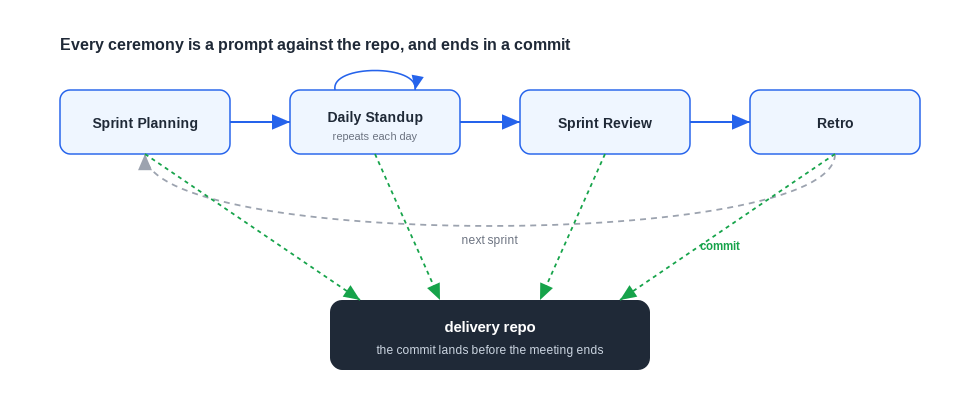
Planning, standup, review, and retro each run as a prompt against the repo and fire a commit before the meeting ends. 

The same data feeds all of these. 

A single status.md file becomes the morning brief, the risk log, the retro, and the stakeholder report. 

You author once and query many ways. 

Status itself remains human-owned. The assistant drafts it from commits and chat context, but a person reviews and commits the result. Otherwise the no-code days (debugging dead ends, credential issues, design discussions) disappear from the record. 

Where it becomes an asset 

Prompts do not stay prompts. 

A query used a few times becomes a skill. 

The skills, plus the directory structure and conventions, become a scaffold. 

The scaffold becomes reusable. 

The next engagement starts from a template that already knows how stories, sprints, decisions, and ceremonies fit together. 

The cost of standing up a new project keeps dropping because the operating layer already exists. 
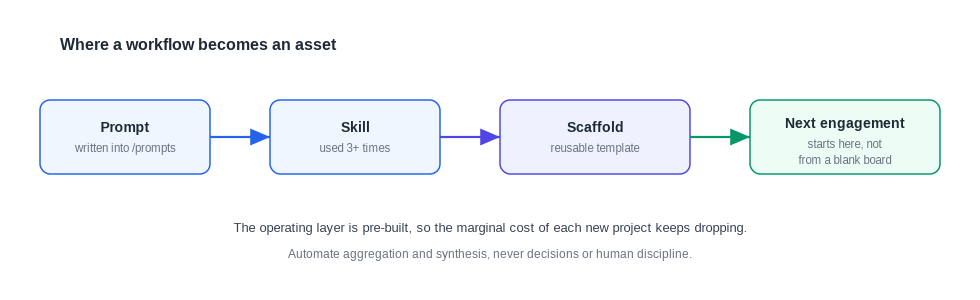
A prompt used repeatedly becomes a skill, the skills and conventions become a reusable scaffold, and the next engagement starts from that template instead of a blank board. 

One principle keeps that from tipping into over-automation: 

Automate aggregation and synthesis. Do not automate judgment. 

Draft the brief. Draft the retro. Draft the report. 

But decisions, scope, priorities, and commitments stay human. 

The moment you automate judgment, the model quietly rots. 

What it costs, honestly 

It isn’t free. 

The committing discipline is load-bearing, and no tool nags you into doing it. 

It assumes the team works in an agent-aware editor. Open these files in a plain editor and much of the leverage disappears. 

Design tools do not go away. Figma and Miro still exist. The repo simply becomes the place where design decisions and handoffs are recorded. 

There are still open questions too. On a small team without dedicated QA, who formally signs off that acceptance criteria have been met? We are still working that out. 

I’d rather name those edges than pretend the model is finished. 

The honest reframe is that this approach does not eliminate the tracker’s job. 

It absorbs it. 

The consistency Jira enforced for free becomes something you own on purpose. 

For the kind of AI-native work we do, that ownership is the point. 

The repo is already where the work happens. 

So we started asking a simple question: 

What happens if coordination happens there too? 

This operating model is our current answer. 

Not because Git is magical. 

Not because Jira is broken. 

Because operational context now accumulates in one place, and we’re interested in what becomes possible when the people, the artifacts, and the assistants all work from the same source. 

Whether this becomes a broader pattern remains to be seen. 

But after working this way, it is difficult to imagine moving the source of truth back into a system designed primarily to describe the work rather than participate in it. 

Pt. 1: Repo-Native Delivery – Why We Ditched Jira for AI Work  

How we moved from Jira + AI connectors to a single repo where humans and agents work from the same source of truth. 

Part 1 of 2: The why. Part 2 walks through the operating model itself. 

Almost every product tool I open lately is reaching for the same idea: put an AI copilot on top of the backlog. Jira has Rovo. ServiceNow ships agile story generation that claims to cut epic breakdown by around 80%. Linear, Azure DevOps, and the rest are adding a button that turns a fuzzy feature into a tidy stack of tickets. 

That is genuinely useful. I do not want to wave it away. 

The version I run into most these days is subtler. Plenty of teams now connect Jira to their AI assistant as an MCP connector (in Claude’s Cowork, for instance) so the assistant can read and update tickets for them. For a solo PM, that can feel like a small miracle. The assistant can summarize the board, draft updates, and move work along without the usual tab-hopping. 

But the shape of the system has not really changed. 

The tracker is still a second system the AI has to reach into over an API, one round trip at a time. Someone still has to keep that system in sync with the work. The integration layer did not disappear. It just got automated. 

Which leaves a more interesting question sitting in the open: 

If AI can generate the work, and read the work, do we still need the tracker to be the home of the work? 

At Robots & Pencils we build AI products for enterprises, which means we have felt the gap between how these systems get built and how we were managing the building. On a recent enterprise pilot, I started an experiment: run delivery without Jira as the source of truth. 

Generate the epics and stories from a skills pipeline. Let the whole team (PM, designer, engineer) work out of a Git repo where stories, sprints, and decisions are versioned markdown files. 

The goal was not a tidier way for me, the PM, to manage a project from my own AI session. That would have been a nicer cockpit, not a better operating model. 

The goal was to put the whole team on one source: the engineer in their editor, the designer in theirs, no connector in the middle, and nobody waiting on me to sync a board. 

It worked well enough that it is quietly becoming how we deliver AI-native work. 

This piece is the why. The next one is the how. 

The tell: who’s doing the integrating 

Jira makes the human the integration layer. 

The work is there, but it is scattered into pieces: the ticket, the related tickets, the research doc, the decision from three weeks ago, the acceptance criteria that changed in grooming, the Slack thread nobody quite remembers. 

Before anyone can move, someone has to stitch the picture together. 

That was a reasonable deal when the only thing that could read a ticket was a human. 

It’s a worse deal now. 

The assistant doing more of the building can read the surrounding context, if the context is somewhere it can actually reach. When a story is a markdown file in the repo, the assistant can take in the story, the technical spec, the grooming notes, and the code itself in one pass, because they’re all just files in the same working surface. 

Nobody has to describe the map. The assistant can follow the links. 

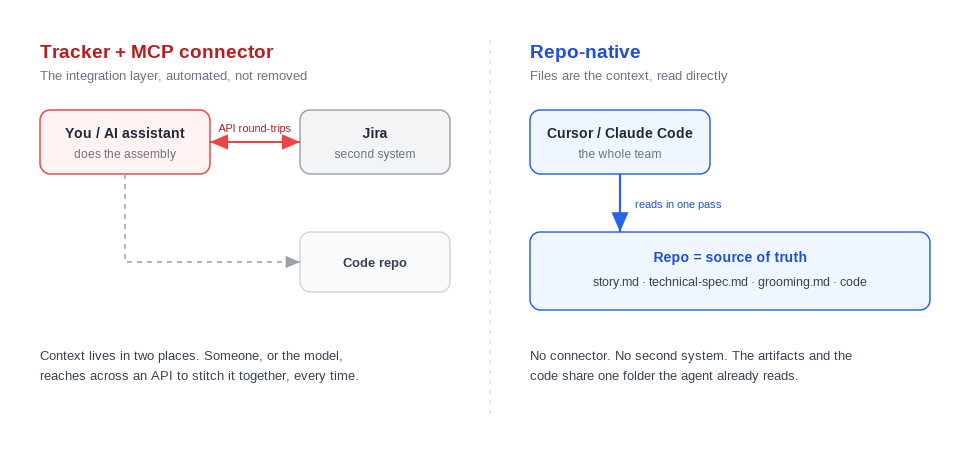
Wiring the tracker into an AI assistant over MCP is still progress. It hands some of that assembly work to the assistant. But it also preserves the old shape: second system, API round trips, and a project record that has to be kept aligned with the place where the work is actually happening. 

Repo-native delivery asks for a cleaner cut. 

Move the artifacts to where the work and the AI already live, and the integration layer stops being a person. 

Tracker-plus-MCP keeps a second system and API round-trips; repo-native lets the editor read story, spec, grooming, and code in one pass. 

What about Linear? 

Linear is excellent. It is what a better tracker looks like: clean, fast, developer-friendly, with strong GitHub integration and improving AI. Plenty of teams, including parts of ours in the past, moved happily from Jira to Linear. 

But even Linear is still a tracker. The work artifacts live in Linear’s database. The AI reaches in through integrations. Engineers still cross from the issue tracker to their editor and back. The fundamental shape, a separate coordination system sitting next to the execution environment, stays intact. 

Repo-native delivery goes one step further. It asks whether we still need that separate system at all, once context is cheap and an assistant can read across stories, specs, decisions, and code in one pass. We are not trying to replace Jira or Linear with a nicer interface. We are moving the source of truth into the environment where the work, and the agents, already live. 

What changes when the repo is the truth 

The benefit I expected was speed. 

The benefit that actually mattered was quieter seams between people. 

The engineer felt it first. Their coding agent could open a story with the real acceptance criteria in context, not a paraphrase pasted into a chat window. That meant the agent built toward the definition of done instead of drifting toward a plausible interpretation of it. 

Even better, the criteria became something the agent could check its own work against. The story was not just an instruction. It was the contract. 

And the engineer never left the editor to find any of it. The story, the plan, and the reasoning sat beside the code, not behind another login. 

Handoffs changed too. 

A designer could drop an artifact and a one-line note into the story folder, and the next person’s editor would read it when they opened the story. No tagging. No “did you see my message?” No quiet dependency on someone remembering to move context from one place to another. 

The same source also starts feeding many views. One status.md file can become the morning brief, the sprint risk log, the retro, and the stakeholder report. 

You author once and query many ways. 

That is where the repo has an advantage over the tracker. A tracker’s data mostly feeds the tracker’s own views. Repo data feeds anything a team can write a prompt for. 

The query I lean on most isn’t a fancy one. Each morning, instead of asking the team what they did yesterday, I ask the repo. 

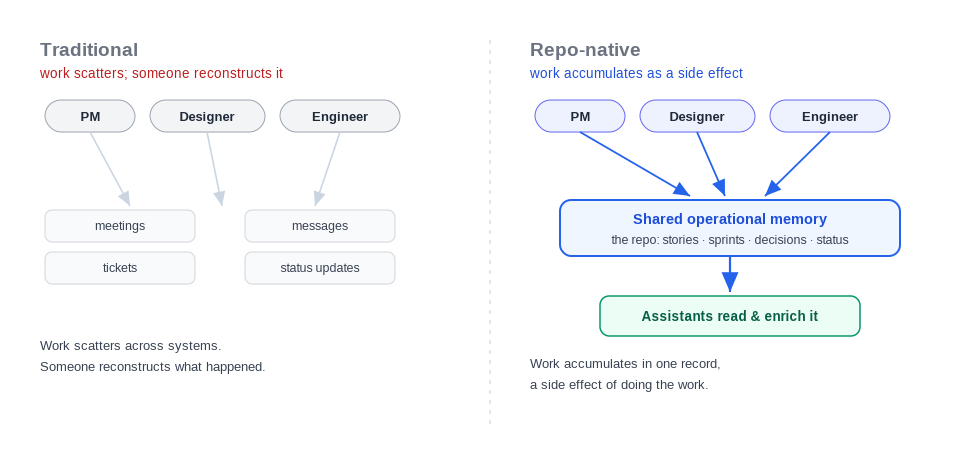
Traditional: each role’s work scatters into meetings, messages, tickets, and status updates that someone reconstructs later. Repo-native: every role’s work accumulates in one shared operational record that assistants read and enrich. 

Jira is a coordination layer. The repo is where execution happens. 

The same assistant helping implement a story can also summarize sprint risk, trace dependencies, draft stakeholder updates, and explain why a decision was made. 

When the same system can participate in both coordination and execution, the boundary between the two starts to look less inevitable. 

That shift shows up in small ways at first. 

The prompts we run do not stay prompts. A query used a few times becomes a skill. The skills, plus the repo structure and conventions, become a scaffold. And that scaffold is portable. 

The next engagement does not begin with an empty Jira project. It begins from a template that already knows how stories, sprints, decisions, prompts, and ceremonies fit together. The operational cost of standing up a new project drops because the operating layer already exists. 

That is what turns a workflow into a capability. 

It also reframes the PM’s job. 

When a skill can draft the stories, the PM’s edge moves upstream: framing the right epics, encoding judgment into the pipeline, and curating the context the whole team’s tools draw from. 

The craft shifts from producing the backlog to designing the system that produces it. 

The judgment was always there. Now it has somewhere explicit to live. 

Maybe the bigger question is not how we teach our trackers to work with AI. 

Maybe it is whether the work still needs a separate coordination system at all. 

Was the tracker ever the right home for the work in the first place? 

Ours moved into the repo, and it has not asked to move back. 

Stay tuned for Part 2, where Nilesh walks through the operating model: the two-repo pattern, the story directory, the sprint-as-narrative, and how every ceremony ends in a commit, so you can copy it, not just nod at it. 

Context Engineering is the Part of RAG Everyone Skips  

This moment is familiar. A “simple” policy question comes up, and the conversation slows to a halt. Not because the answer is unknowable, but because it’s buried somewhere in a 100-page PDF, inside a binder no one wants to open, on an intranet that technically exists but rarely helps when it matters. 

Under time pressure, people do what people always do. They ask around. They rely on memory. They make the best call they can with what they recall. 

That’s the situation many organizations quietly operate in. Field teams losing meaningful time every shift just trying to locate procedures. Compliance leaders increasingly uneasy with how often answers came from tribal knowledge. The documents exists. Access technically exists. What’s missing is usable context. 

When Policy Knowledge Exists but Usable Context Does Not 

The obvious move is to build a RAG (Retrieval-Augmented Generation) assistant. 

That’s where the real work begins. 

What we didn’t fully appreciate at first was that this wasn’t a retrieval problem. It was a context construction problem. 

The challenge wasn’t finding relevant text. It was deciding what the model should be allowed to see together. In hindsight, this had less to do with RAG mechanics and more to do with what we’ve come to think of as context engineering: deliberately designing the context window so the model sees complete, coherent meaning instead of fragments. 

Where the “Obvious” Solution Fell Short 

We didn’t start naïvely. We explored modern RAG patterns explicitly designed to reduce context loss. Parent–child retrieval, hierarchical and semantic chunking, overlap tuning, and filtered search strategies. These approaches are widely used in production for structured documents, and for good reason. 

They did perform better than baseline setups. 

But for these policy documents, the same failure mode kept showing up. 

Answers were fluent. Confident. Often almost right. 

Procedures came back incomplete. Steps appeared out of order. Exact wording, phone numbers, escalation paths, timelines – softened or blurred. And when the model couldn’t see the missing context, it filled the gaps with something plausible. 

Why “Almost Right” Answers Are Dangerous in Compliance & Procedural Work 

At that point, the issue was no longer retrieval quality. 

It was context loss at decision time. 

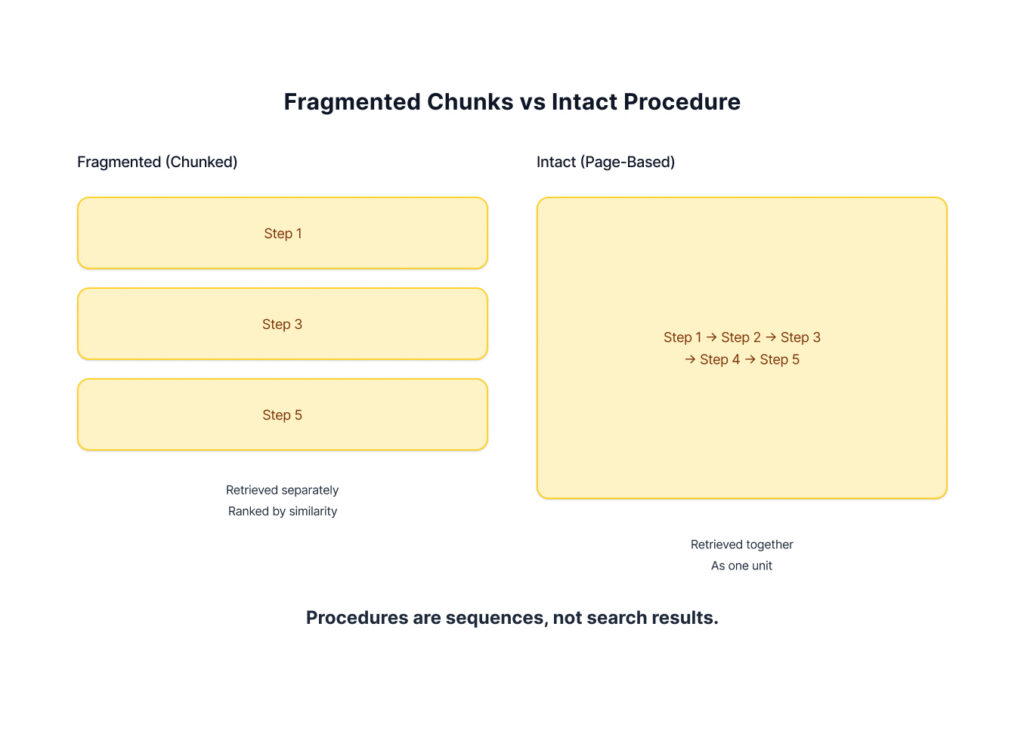
A procedure isn’t just information. It’s a sequence with dependencies. Even when parent documents were pulled in after similarity-based retrieval, the choice of which parent to load was still probabilistic, driven by embedding similarity rather than document structure. 

In compliance-heavy environments, “coherent but incomplete” is an uncomfortable place to land. 

This became the line we couldn’t ignore: 

Chunking isn’t a neutral technical step. It’s a design decision about what context you’re willing to lose and when. 

Chunking Is a Design Choice About Risk 

Most modern RAG systems correctly recognize that context matters. Parent–child retrieval and hierarchical chunking exist precisely because naïve fragmentation breaks meaning. 

What many of these systems still assume, though, is that similarity-first retrieval should remain the primary organizing principle. 

Why Similarity-First Retrieval Breaks Policy Logic 

For many domains, that’s a reasonable default. For large policy documents, it turned out to be the limiting factor. 

Policy documents reflect how institutions think about responsibility and risk. They’re organized categorically. They use deliberate, constrained language like – within 24 hours, contact this number. And their most important procedures often span pages, not paragraphs. 

When that structure gets flattened into ranked results, even if parent sections are expanded later – similarity still decides which context the model sees first. 

And when surrounding context disappears, the model does what it’s trained to do: it narrates. 

Not recklessly. Not maliciously. 

Just helpfully. 

That was the subtle failure mode we kept encountering – the system becoming a confident narrator when what the situation required was a careful witness. 

Naming the Problem Changed the System 

Once we framed this as a context engineering problem, the architecture shifted. 

Instead of asking, “How do we retrieve the most relevant chunks?” we started asking a different question: 

What does the model actually need to see to answer this safely and faithfully? 

That reframing moved us away from similarity-first defaults and toward deliberate context construction. 

In retrospect, this wasn’t a rejection of modern RAG techniques. It was a refinement of them. 

The Design Decisions That Actually Changed Outcomes 

Once the problem was named clearly, a small set of design decisions emerged as disproportionately impactful. None of these ideas are novel on their own. What mattered was how they were combined. 

Classify First, Then Retrieve 

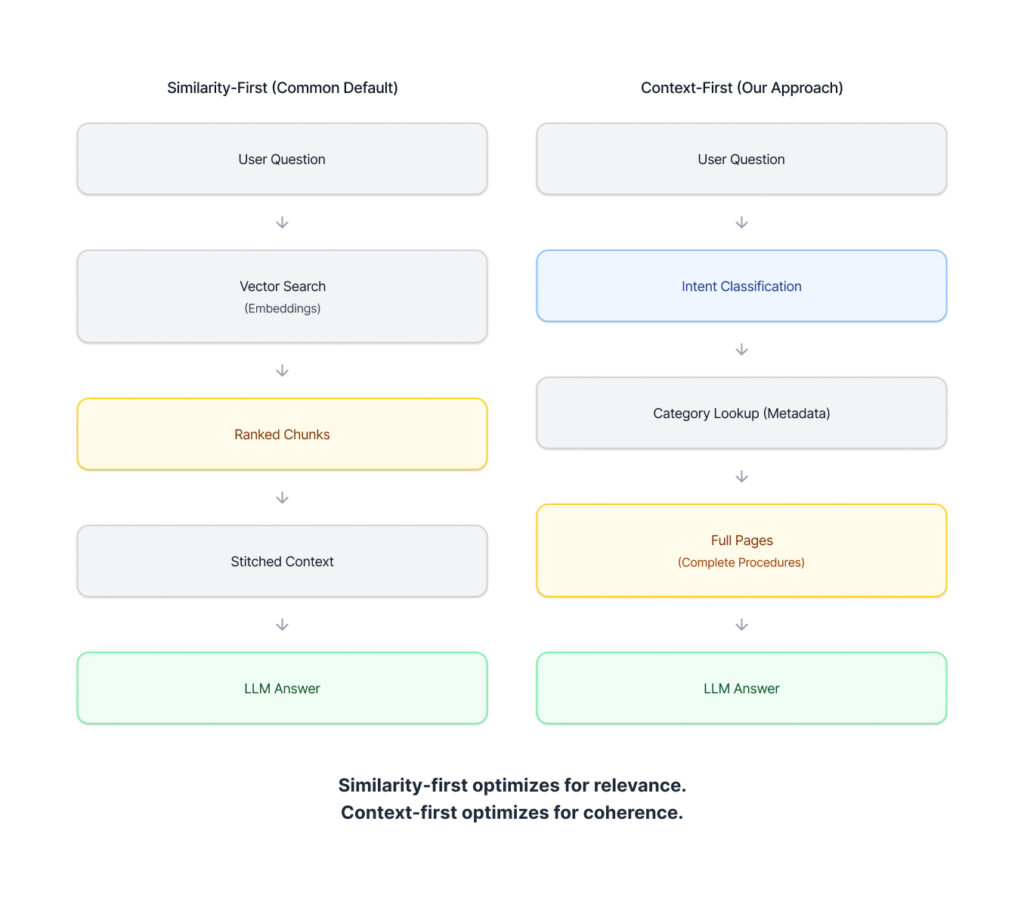
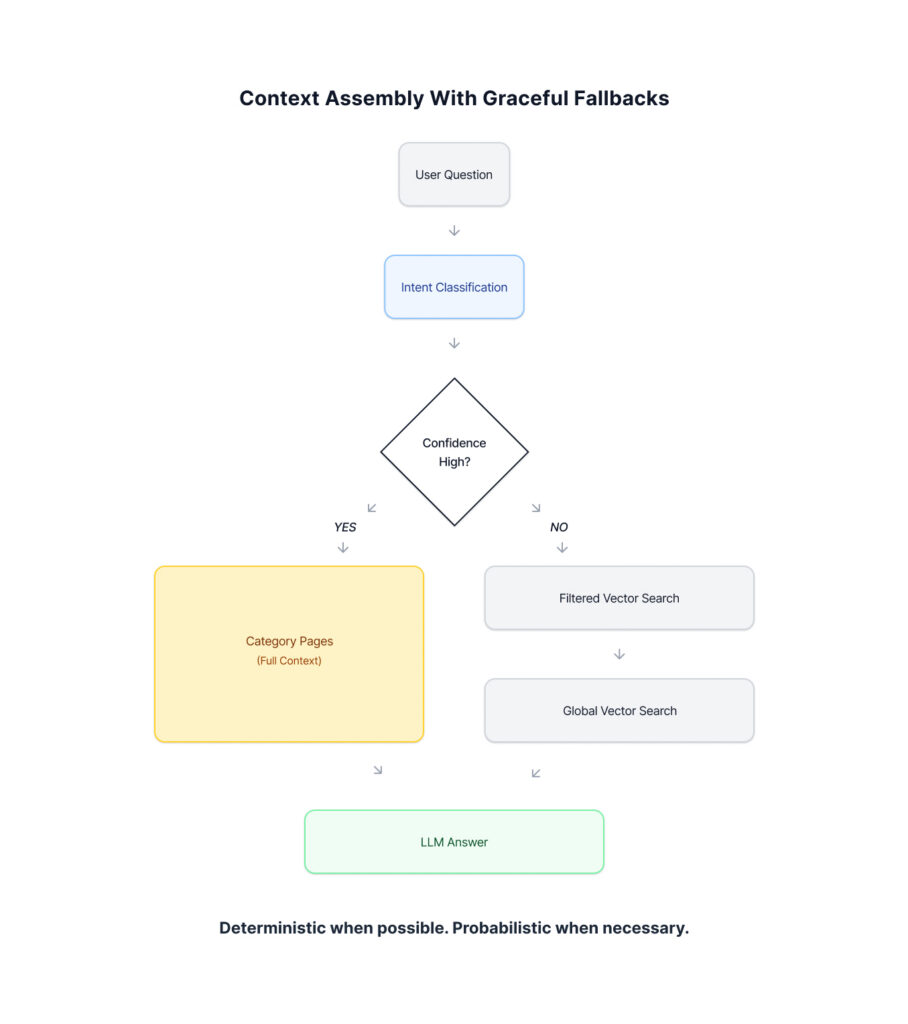
Before touching the vector store, the system classifies what the user is asking about. An LLM determines the query category and confidence level. 

When confidence is high, full pages from that category are loaded via metadata lookup – no embedding search required. 

When confidence is low, the system falls back to chunk-based vector search, not as the default, but as a safety net for ambiguous or cross-cutting questions. 

You can think of this as parent–child retrieval where the parent is selected deterministically by intent, rather than probabilistically by similarity. 

Dual Document Architecture 

Location-specific documents were separated from company-wide documents, each with its own taxonomy. “What’s the overtime policy?” and “Where’s the emergency exit?” require fundamentally different context. 

Domain-Specific Taxonomy 

Categories were designed to align with how policy documents are actually authored, not how users phrase questions. Categories were assigned at upload time, not query time, making retrieval deterministic and fast. 

Token-Aware Page Loading 

Even full pages can exceed context limits. Dynamic loading prioritizes contiguous pages and stops when the token budget is reached. The tradeoff was intentional: complete procedures beat partial matches. 

The Big Lesson: Context Is the Real Interface Between Policy and AI Judgment 

Context is easy to treat as plumbing – important, but invisible. 

In reality, context is the interface between an organization’s reality and a model’s generative capability. 

So yes, modern RAG techniques matter. 

But in systems built around policy, safety, and compliance, the sequence in which they’re applied matters more than we usually admit. Not because it helps the model answer faster but because it helps the model answer without taking liberties. 

If you’re building RAG for policy, compliance, or any domain where fidelity matters more than speed, it’s worth pausing to ask, “What context actually needs to be present?” That question alone can lead to systems that are simpler and ultimately more trustworthy than expected. 

It’s also worth noting: These patterns are particularly relevant in environments where data residency or deployment constraints limit the use of cloud-hosted models. That constraint sharpened every design decision, and it’s a story worth exploring separately. 

The pace of AI change can feel relentless with tools, processes, and practices evolving almost weekly. We help organizations navigate this landscape with clarity, balancing experimentation with governance, and turning AI’s potential into practical, measurable outcomes. If you’re looking to explore how AI can work inside your organization—not just in theory, but in practice—we’d love to be a partner in that journey. Request an AI briefing. 


Key Takeaways 


FAQs 

What is context engineering in RAG systems? 

Context engineering is the deliberate design of what information an LLM sees together in its context window. It focuses on preserving complete meaning, sequence, and dependencies rather than optimizing for similarity scores alone. 

Why does retrieval order matter for policy documents? 

Policy documents encode responsibility, timelines, and escalation paths across sections. When retrieval order fragments that structure, models produce answers that sound correct while missing critical steps or constraints. 

Why do RAG systems hallucinate in compliance scenarios? 

They usually do not hallucinate randomly. They infer missing steps when surrounding context is absent. This happens when procedures are split across chunks or retrieved out of sequence. 

When should similarity-based retrieval be avoided? 

Similarity-based retrieval becomes risky in domains where sequence and completeness matter more than topical relevance, such as safety procedures, regulatory policies, and escalation protocols. 

How does classifying before retrieval improve accuracy? 

Intent classification allows systems to load entire, relevant sections deterministically. This ensures the model sees complete procedures rather than fragments selected by embedding proximity. 

Is this approach compatible with modern RAG architectures? 

Yes. It refines modern RAG techniques by sequencing them differently. Vector search becomes a fallback for ambiguity rather than the primary organizing principle. 

Does this approach require proprietary models or cloud infrastructure? 

No. The system described was built using open-source LLMs running locally, which increased the importance of careful context design and eliminated data exposure risk. 

Beyond Wrappers: What Protocols Leave Unsolved in AI Systems 

I recently built a Model Context Protocol (MCP) integration for my Oura Ring. Not because I needed MCP, but because I wanted to test the hype: Could an AI agent make sense of my sleep and recovery data? 

It worked. But halfway through I realized something. I could have just used the Oura REST API directly with a simple wrapper. What I ended up building was basically the same thing, just with extra ceremony. 

As someone who has architected enterprise AI systems, I understand the appeal. Reliability isn’t optional, and protocols like MCP promise standardization. To be clear, MCP wasn’t designed to fix hallucinations or context drift. It’s a coordination protocol. But the experiment left me wondering: Are we solving the real problems or just adding layers? 

The Wrapper Pattern That Won’t Go Away 

MCP joins a long list of frameworks like LangChain, LangGraph, SmolAgents, and LlamaIndex, each offering a slightly different spin on coordination. But at heart, they’re all wrappers around the same issue, getting LLMs to use tools consistently. 

Take CrewAI. On paper, it looked elegant with agents organized into “crews,” each with roles and tools. The demos showed frictionless orchestration. In practice? The agents ignored instructions, produced invalid JSON even after careful prompting, and burned days in debugging loops. When I dropped down to a lower-level tool like LangGraph, the problems vanished. CrewAI’s middleware hadn’t added resilience, it had hidden the bugs. 

This isn’t an isolated frustration. Billions of dollars are flowing into frameworks while fundamentals like building reliable agentic systems remain unsettled. MCP risks following the same path. Standardizing communication may sound mature, but without solving hallucinations and context loss, it’s just more scaffolding on shaky foundations. 

What We’re Not Solving 

The industry has been busy launching integration frameworks, yet the harder challenges remain stubbornly in place: 

As CData notes, these aren’t just implementation gaps. They’re fundamental challenges. 

What the Experiments Actually Reveal 

Working with MCP brought a sharper lesson. The difficulty isn’t about APIs or data formats. It’s about reliability and security. 

When I connected my Oura data, I was effectively giving an AI agent access to intimate health information. MCP’s “standardization” amounted to JSON-RPC endpoints. That doesn’t address the deeper issue: How do you enforce “don’t share my health data” in a system that reasons probabilistically? 

To be fair, there’s progress. Auth0 has rolled out authentication updates, and Anthropic has improved Claude’s function-calling reliability. But these are incremental fixes. They don’t resolve the architectural gap that protocols alone can’t bridge. 

The Evidence Is Piling Up 

The risks aren’t theoretical anymore. Security researchers keep uncovering cracks: 

Meanwhile, fragmentation accelerates. Merge.dev lists half a dozen MCP alternatives. Zilliz documents the “Great AI Agent Protocol Race.” Every new protocol claims to patch what the last one missed. 

Why This Goes Deeper Than Protocol Wars 

The adoption curve is steep. Academic analysis shows MCP servers grew from around 1,000 early this year to over 14,000 by mid-2025. With $50B+ in AI funding at stake, we’re not just tinkering with middleware; we’re building infrastructure on unsettled ground. 

Protocols like MCP can be valuable scaffolding. Enterprises with many tools and models do need coordination layers. But the real breakthroughs come from facing harder questions head-on: 

These problems exist no matter the protocol. And until they’re addressed, standardization risks becoming a distraction. 

The question isn’t whether MCP is useful; it’s whether the focus on protocol standardization is proportional to the underlying challenges. 

So Where Does That Leave Us? 

There’s nothing wrong with building integration frameworks. They smooth edges and create shared patterns. But we should be honest about what they don’t solve. 

For many use cases, native function calling or simple REST wrappers get the job done with less overhead. MCP helps in larger enterprise contexts. Yet the core challenges, reliability and security, remain active research problems. 

That’s where the true opportunity lies. Not in racing to the next protocol, but in tackling the questions that sit at the heart of agentic systems. 

Protocols are scaffolding. They’re not the main event. 

Learn more about Agentic AI. 

The pace of AI change can feel relentless with tools, processes, and practices evolving almost weekly. We help organizations navigate this landscape with clarity, balancing experimentation with governance, and turning AI’s potential into practical, measurable outcomes. If you’re looking to explore how AI can work inside your organization—not just in theory, but in practice—we’d love to be a partner in that journey. Request a strategy session.