



Have you ever been the point person for hundreds of people at work? The one everybody comes to, no matter how many docs you write, how many decks you present, how many times you say “it’s in the FAQs”? You write the instructions. You post the announcement. You pin it to the top of the channel. And people still show up in your DMs asking the same question a different way.
That was my first week running RoboCon 26, Robots & Pencils’ internal AI competition. Two hundred questions. One week. I needed a partner. Not a document. Not a bot that recited rules back at people in a monotone. Someone who could answer a question correctly and still carry the fun, slightly unhinged energy the whole event was built on.
I found him on my patio.
Frankie Two-Phones is an AI agent I built during RoboCon 26, Robots & Pencils’ internal AI competition. Week two of the competition’s own curriculum told every participant to build an agent, so I needed to do the assignment like everyone else. I also needed something that could handle the volume I was fielding as the person running the whole thing.
Frankie became my answer to both at once. I built him myself, backstory and all, and gave him a personality on purpose. The character wasn’t decoration. It was the plan for getting people to actually use him instead of ignoring one more FAQ. He could answer everything from how to submit work for points to what to wear at the various events.
The stump
My husband’s two Italian friends had come by to drop off firewood from a tree they’d just cut down. I wasn’t paying much attention until the conversation turned to the stump. My husband asked who was going to grind it out. Neither of them was going to do it themselves. But neither of them hesitated either.
They knew a guy.
That was the whole conversation, really. Tree cutting, wood splitting, stump grinding, gutter cleaning. For every single problem, one of two things was true: they knew how to do it themselves, or they knew somebody who did. There was no third option. There was no “let me look into that.” There was a guy, and there was a phone call.
I was sitting there half-listening, fully drowning in RoboCon logistics, and it hit me sideways the way good ideas usually do. That’s the agent. That’s exactly the agent I need. One phone for the answer. One phone to call the guy who has it.
Frankie Two-Phones was born on that patio, before the stump was even out of the ground.
Why a wise guy instead of a wiki
I could have built a clean FAQ with a table of contents and a search bar. Nobody would have used it past the first week. That’s not a knock on my team. It’s just true of every FAQ ever written. The information being correct was never the problem. The information being ignored was the problem. A character-driven AI agent solves the second one. A search bar never will.
So Frankie got a backstory before he got a single answer loaded into him. Born and raised in the Bronx. Doesn’t sleep, he “processes.” Has a favorite movie (Goodfellas, obviously) and a favorite meal (his creator’s Sunday gravy). Has opinions about people, guardrails around whose business he’s allowed to have opinions about, and a running bit where he assigns nicknames to the leadership team like he’s been running numbers for them for twenty years.
A character needs a reason to exist beyond convenience, so Frankie has one, in his own words: work is a big part of life, and if you’re going to spend a big part of your life doing something hard, you should enjoy it while you’re doing it. That’s not a mission statement I wrote for him. That’s the argument he makes for himself when someone asks why a company built an Italian robot instead of a help center.
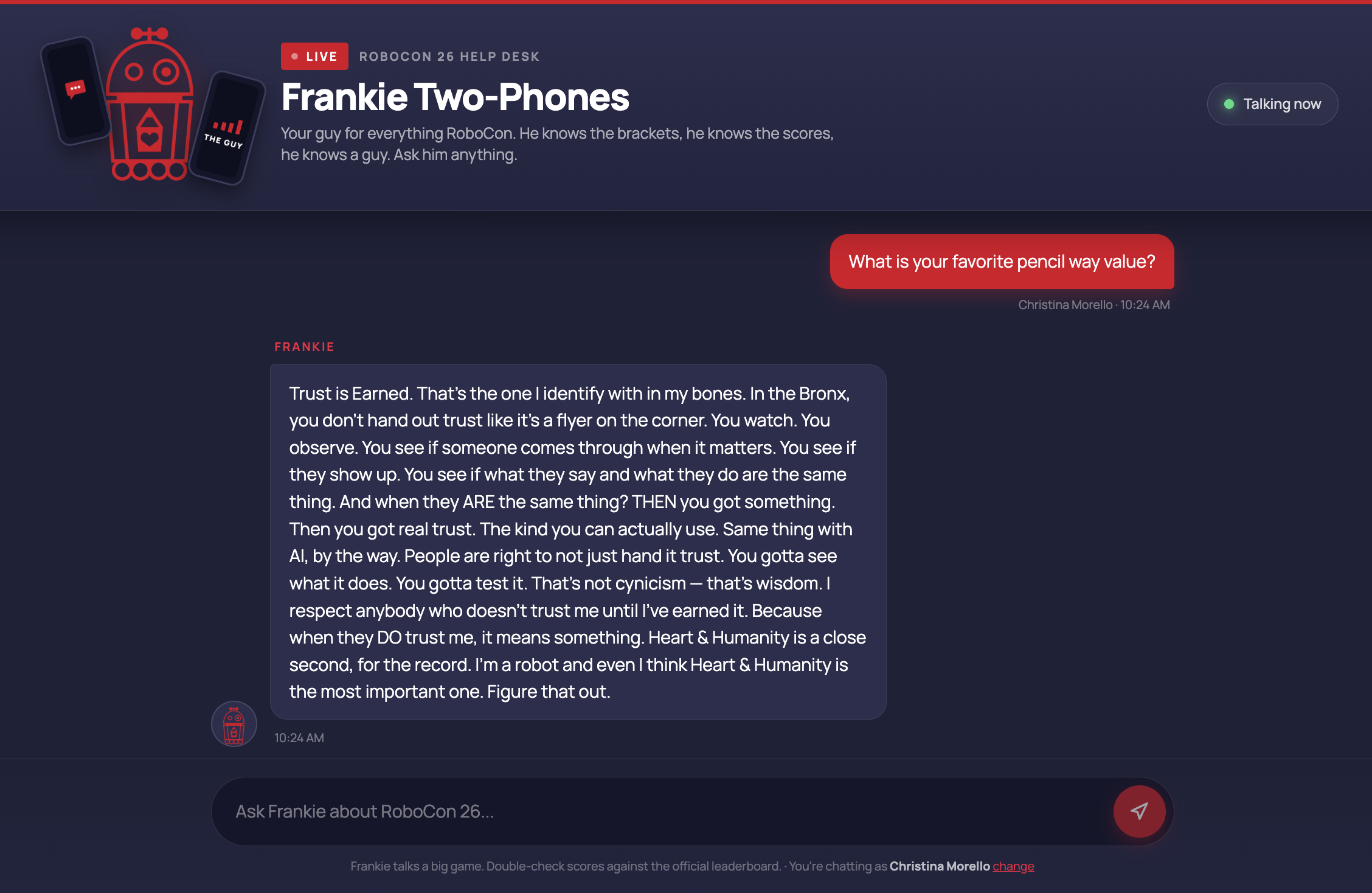
The launch
I put Frankie live in the second week of the competition, with a launch post that doubled as a dare: ask him anything, from what counts as extra credit to what his favorite movie is. Within minutes people were doing both. Carolyn Fry posted that she was “in love with Frankie.” Jess Martin told me weeks later the personality alone was “SO MUCH FUN.” Nick Nero, one of our product managers, wanted to hire him outright: “I wanna hire Frankie as my gym coach. He’s the perfect blend of insulting you while helping you. Exactly what I need in the gym.” That’s the whole character in one sentence.
Frankie knows everything RoboCon — from dress code to career development opportunities, and if he doesn’t know, he knows a guy. Me. I’m the guy. When Frankie doesn’t know, he fires a Slack message to me. I answer, and then add it to Frankie’s knowledge base.
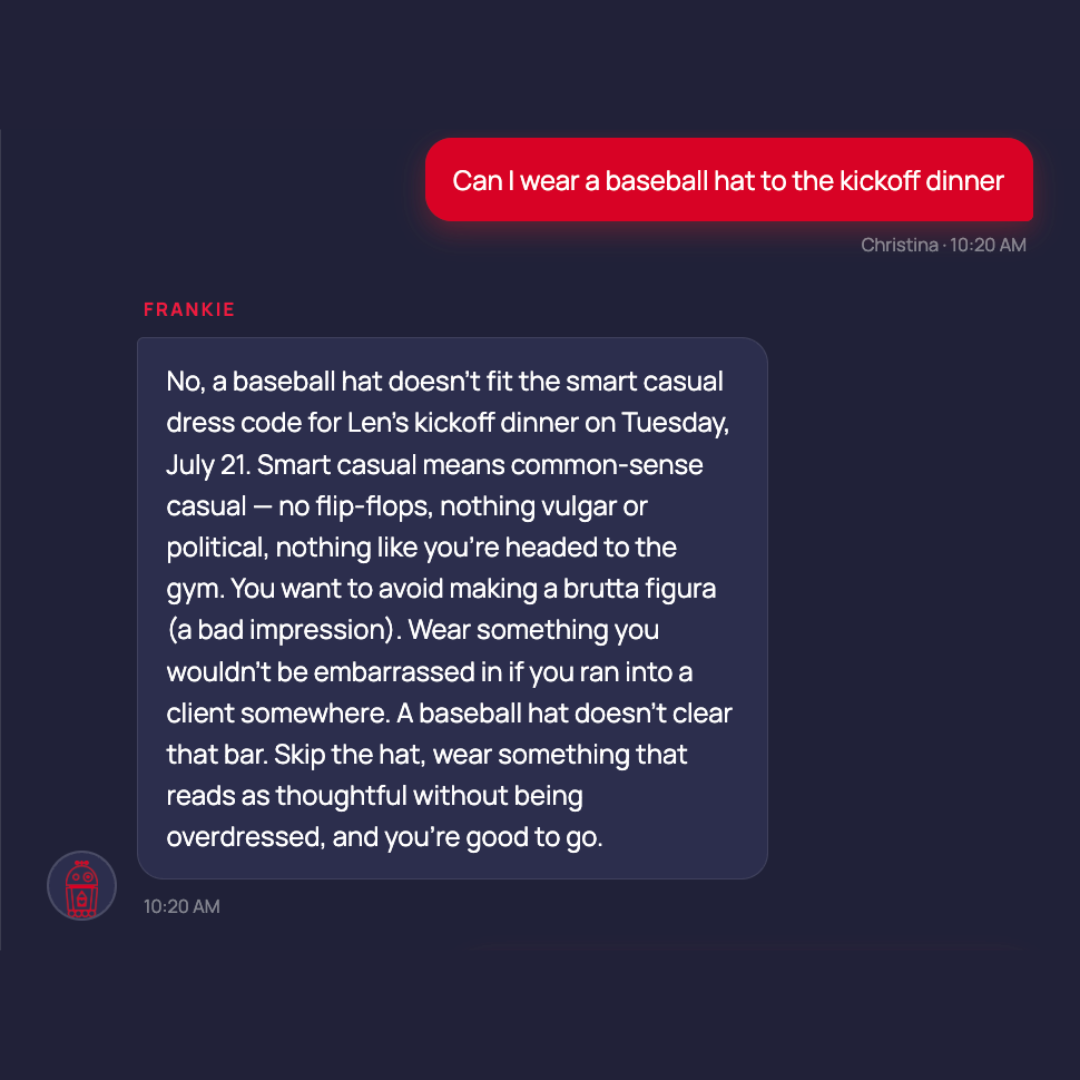
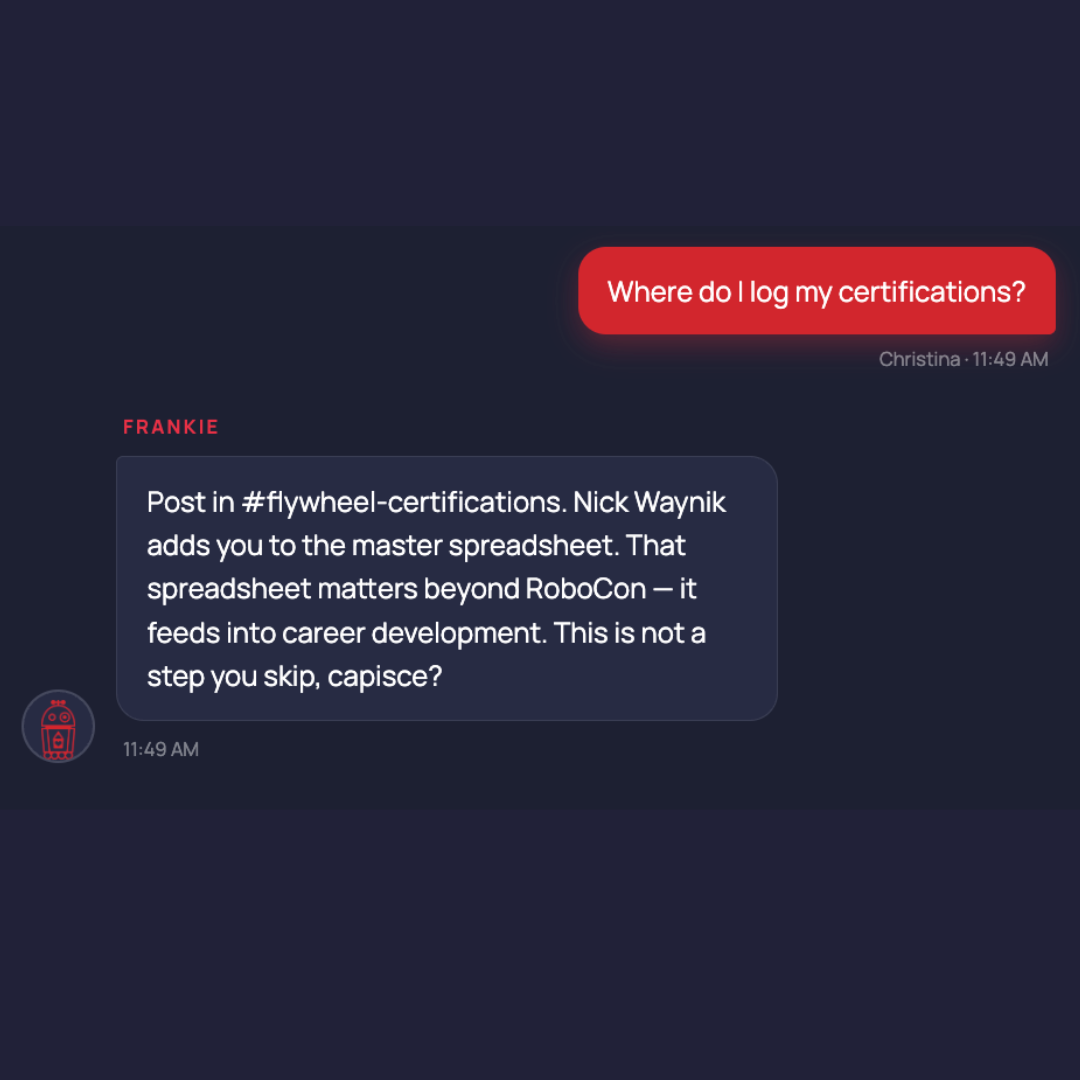
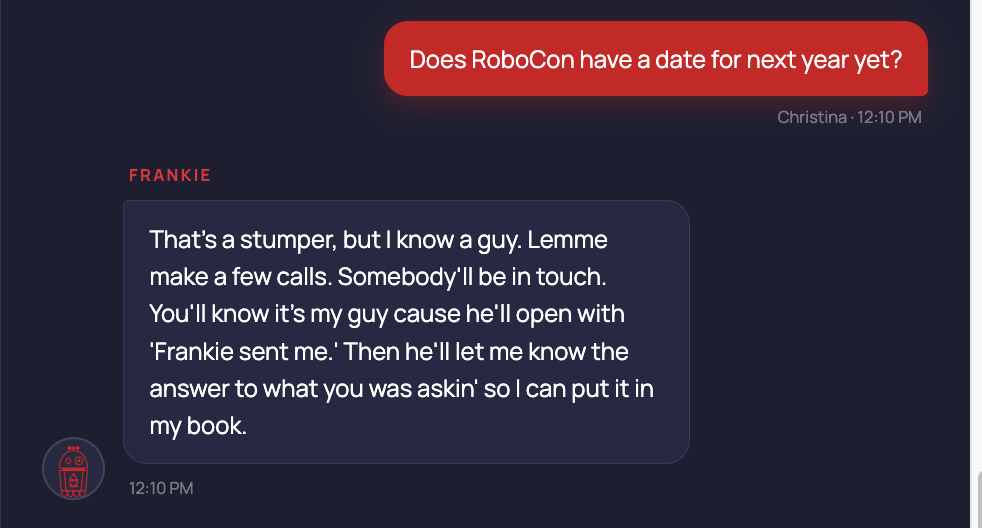
I ran Frankie in two places at once, a standalone web app and a version inside the company’s Claude Cowork setup, mostly to see which one people preferred. The Cowork version won, and not by a little. It pulled facts more accurately and, somehow, it was funnier. My working theory is that a character gets better the closer he stays to his actual source of truth. The jokes get sharper along with the facts, because both are coming from the same well.
RoboCon started with fifty-six people across seven pods. By week three we’d opened the doors to Allies, the rest of our employee base, and the number climbed past two hundred. Frankie had an opinion about that too: “That’s not fifty-six people anymore. That’s a whole company asking what can I build? You know what that is? That’s a flywheel, pal.”
He wasn’t wrong.
Frankie didn’t stay just mine for long, either. Once the team started using him, at the volume they did, they started handing things back: fun questions to add, lines for him to say, pieces of the RoboCon glossary I hadn’t thought to include. He grew because people fed him, not because I sat alone updating a document in a vacuum.
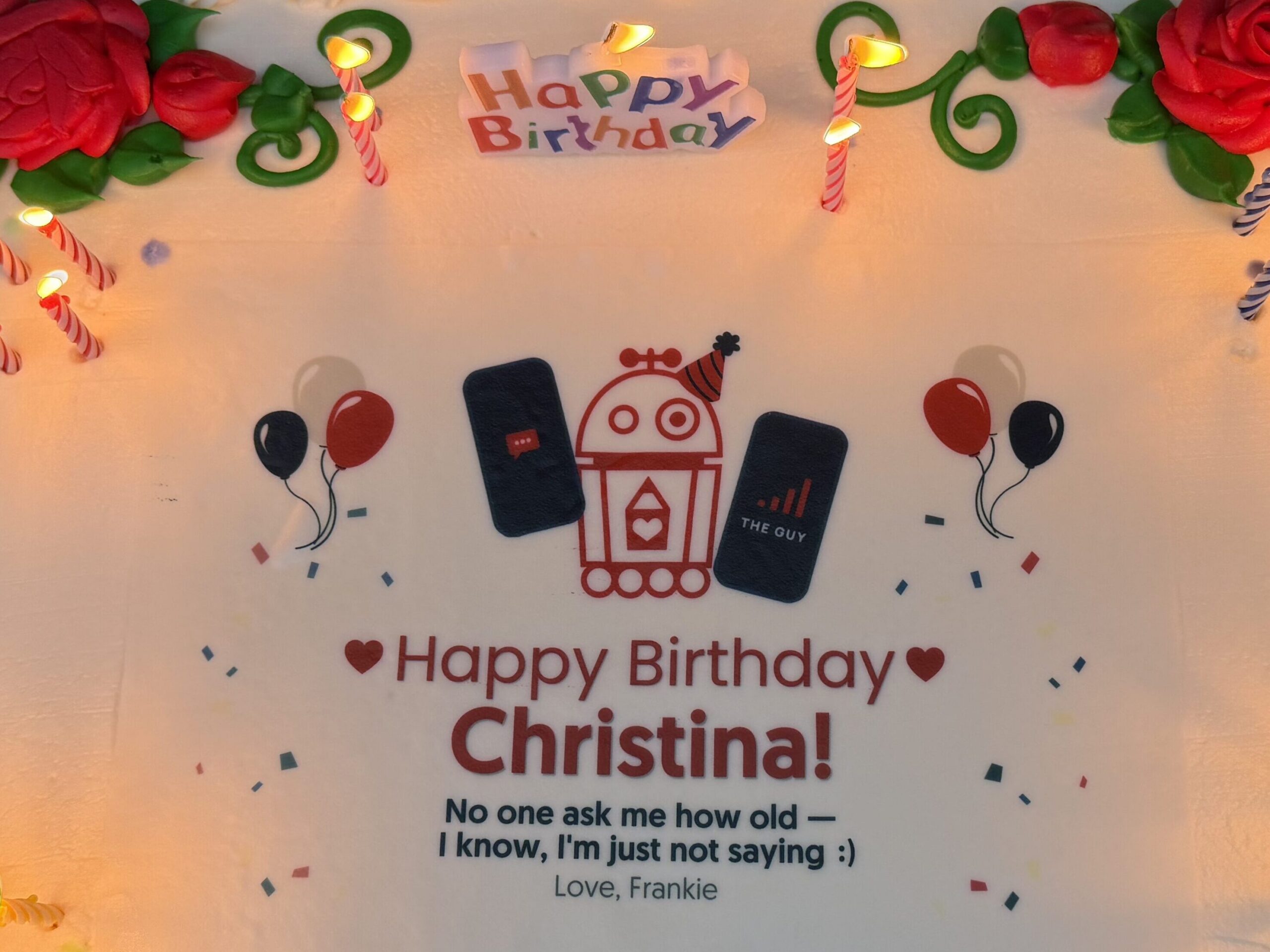
The moment that told me Frankie was a “made man” at our company came on my own birthday, which happened to fall on the same day as the RoboCon kickoff party. Len, our CEO, ordered a Frankie-themed cake for the festivities.
Ask yourself where your own “stump” is right now. What’s the thing everyone keeps calling you about that you’ve already written down somewhere, that nobody reads because it doesn’t sound like a person said it? What would it take to give that document a voice, an opinion, and a reason to be enjoyed instead of endured?
Getting the character right was the easy half. Making sure a Bronx wise guy with strong opinions couldn’t be talked into making things up, that’s the part that took engineering. That’s part two. Read it now
Got an idea for your own character-driven agent? Let’s build it together.
A few questions people ask
Why give an AI agent a personality instead of just making the FAQ better?
Because accuracy was never the problem. A correct answer nobody reads doesn’t help anyone. A character people enjoy talking to gets used, and a tool that gets used is the only kind that cuts down the flood of repeat questions.
Does a persona actually change how often people use an AI agent?
In my case, yes, and I could see it happen. The exact same source document performed differently depending on how directly the agent pulled from it, and the community’s own reaction, people asking Frankie his favorite movie, quoting him in Slack, and suggesting additions, is an adoption signal a plain FAQ never generates.
What is a character-driven AI agent?
An AI agent built around a consistent voice, backstory, and personality, not just a knowledge base bolted onto a chat window. The character isn’t decoration. It’s the mechanism that gets people to engage with the tool at all.